


Loading cart...

ARRI Signature Primes: Large Format Glass
ARRI & Cine Visuals Present: ARRI Signature Primes
Cinematic Heritage
When speaking about ARRI Signature Primes, it is impossible not to begin with ARRI itself. Founded in 1917 in Munich, the company has spent more than a century refining tools not for spectacle alone, but for storytellers. From film cameras to digital cinema systems, ARRI’s reputation has always rested on engineering that quietly serves artistry. It feels almost poetic that 1917 is both the year ARRI was founded and the title of one of the most celebrated films shot on Signature Primes – “1917”, photographed by Roger Deakins BSC, ASC. That film, which won the Academy Award for Best Cinematography, helped introduce the world to ARRI’s large-format system – not just the camera, but the glass that would define it.
The Signature Primes were released in 2018 alongside the ARRI Alexa LF and the new LPL mount. This was not accidental. ARRI recognized that large-format digital cinematography was not simply about bigger sensors – it required lenses designed specifically for the format. Existing Full Frame photography lenses or adapted cinema glass could cover the sensor, but they were not engineered with the same optical precision, mechanical reliability, and metadata integration that high-end narrative production demanded. ARRI knew cinematographers wanted large-format depth and perspective without sacrificing the tonal nuance and natural rendering ARRI cameras were known for. They did not want overly clinical sharpness. They did not want distortion or mechanical inconsistency across focal lengths. They wanted emotional fidelity. ARRI designed Signature Primes entirely in-house. They were built from the ground up to pair with large-format sensors, HDR workflows, and future-facing capture – but with an aesthetic rooted in classical cinema. Modern lenses. Timeless look.
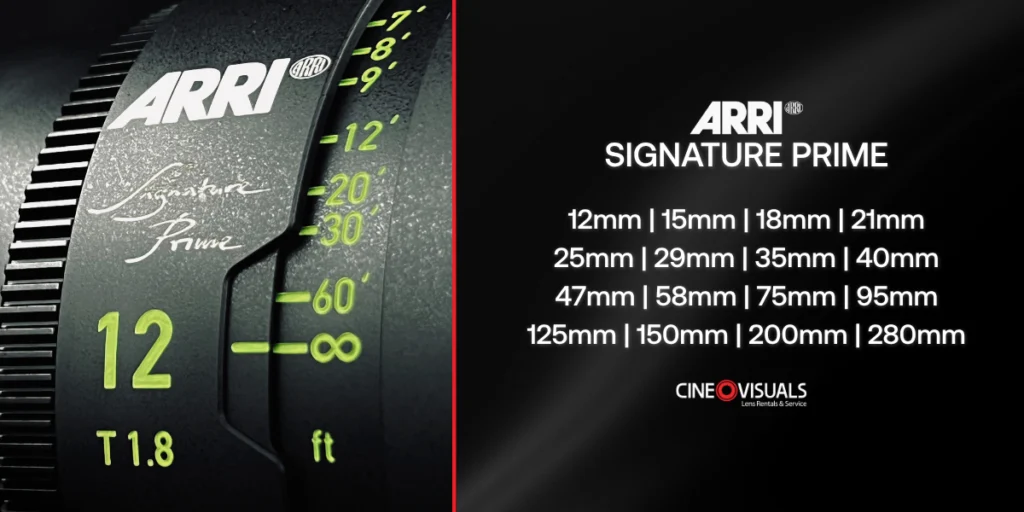
Image Fidelity & Focus
If there is one word repeatedly used to describe the Signature Primes, it is natural. ARRI describes the lenses as offering open shadows, crisp blacks, and exceptional highlight retention. In practice, this translates to smooth tonal roll-off, particularly in skin tones. Highlights do not clip abruptly. Shadows retain subtle gradation. The lenses resolve tremendous detail, but without the harsh edge contrast sometimes associated with ultra-modern optics. Cinematographers frequently comment on the focus falloff. Rather than an abrupt separation between subject and background, the Signature Primes transition gracefully from sharpness into softness. This creates dimensionality without distraction. Focus separation feels organic – the subject is isolated, but not cut out. Another defining trait is the minimal breathing. ARRI engineered the optics so that racking focus does not produce visible image size shifts. For narrative filmmaking, this preserves immersion. Combined with extremely low distortion across the range, the look remains consistent whether you’re on a 21mm or a 75mm. The lenses also maintain uniform contrast and color rendering throughout the set. This consistency allows cinematographers to cut seamlessly between focal lengths without recalibrating the visual language of a scene. On large-format sensors, where depth of field is inherently shallower, this kind of controlled rendering becomes even more critical. Overall, the quality of the glass is impeccable and designed for modern-day digital workflows to maintain a beautiful and filmic image.
Handling & Adaptability
Signature Primes are housed in lightweight magnesium barrels, an intentional choice to reduce fatigue while maintaining durability. Considering the focal range spans from 12mm to 280mm, the physical consistency across much of the set is remarkable. Specifically, 13 of the 16 prime lens set have a 114mm front diameter. On the wider end of the range the 12mm and 15mm have a 134mm and 156mm front diameters respectively. On the telephoto end, the 280mm also has a 134mm front diameter. Out of 16 lenses, there are only three different front diameters with the vast majority of focal lengths sharing a 114mm front diameter, streamlining matte box and accessory setups. Focus rotation is generous at 300º offering precise control for focus pullers. The mechanics are smooth, dampened, and reliable. ARRI’s build quality is immediately apparent. The introduction of the LPL mount was equally significant. Designed specifically for large-format coverage, LPL provides a wider throat diameter and shorter flange depth, allowing for new optical formulas and better illumination across the sensor. It also enables robust lens data transmission via ARRI’s LDS-2 (Lens Data System). Focus distance, iris, and distortion metadata are captured in real time which is invaluable for VFX workflows and post-production precision. Despite their large-format coverage, the lenses range in weight between 3.70 lbs and 9.50 lbs with the majority of focal lengths ranging around 5 lbs. Solid and yet manageable for Steadicam, handheld, and stabilized systems. The consistency across focal lengths reduces rebalance time on set, an often-overlooked advantage during tight production schedules.
Image Circle
At the heart of the Signature Prime design is a 46mm image circle. This generous coverage was built to fully illuminate the Alexa LF (which it was released alongside of) and later the Alexa Mini LF sensors, as well as other large-format digital cinema cameras. The 46mm diagonal comfortably covers Full Frame 35mm digital formats and extends beyond traditional 36x24mm still photography coverage. Thus, the lenses are compatible with a wide variety of cameras and sensor modes – from S35mm to Full Frame and even certain larger-format configurations. This flexibility is one reason they have become a common choice for productions aiming for immersive, cinematic depth. Large-format sensors alter field of view and depth characteristics, and the Signatures were purpose-built to maximize those advantages.
Flare & Bokeh
Flare behavior is controlled but expressive. The coatings are modern and precise, preventing excessive veiling flare, yet they allow subtle, elegant flare characteristics when light sources enter the frame. Highlights bloom gracefully rather than exploding into chaotic artifacts. Cinematographers often mention that the flares feel “cinematic” rather than aggressive. They complement the image instead of dominating it. Combined with the smooth focus falloff, this creates an aesthetic that feels immersive and refined. Signature Primes are often praised for their bokeh. They are beautifully rounded, smooth, and gentle. The iris design and optical formula produce circular out-of-focus highlights, even when stopped down. Rather than harsh-edged discs, the bokeh appears creamy and softly contoured.
These lenses are available for rent at Cine Visuals. For inquiries or testing appointments email info@cinevisuals.com or call (323) 244-2552.