
Loading cart...

Xelmus Apollo: Impressionist Glass in Modern Cinema
Xelmus & Cine Visuals Present: Xelmus Apollo Anamorphics
Cinematic Heritage
In 2015 Oleg Krasyuk and Igor Lobarev forged a dream. As filmmakers themselves, they had a deep love for anamorphic glass and their dreamy, vibrant characteristics. However, the on-set headache of their usage was always a concern and struggle. Anamorphic lenses are typically large, heavy, and cumbersome. For modern, high-speed productions this becomes a constant struggle. Krasyuk and Lobarev wanted to combine modern mechanical designs for lenses with vintage anamorphic elements.
Together, they formed Xelmus. After years of research and development, Krasyuk and Lobarev presented the Xelmus Apollo Anamorphics with a complete set of 40mm, 60mm, and 100mm. Xelmus’ dream had been fulfilled. A combination of beautiful glass inspired by vintage optics with all the technical mastery of modern mechanics. Over time, Xelmus wanted to expand the flexibility of the anamorphic glass they created.. Taking their artistic optical designs, they expanded the focal range. Impressively, the focal range in the primes now spread from 24mm, 32mm, 40mm, 50mm, 60mm, 75mm, 100mm, 135mm, and 180mm, adding a total of six new lenses. As with Xelmus’ vision, adding each of these focal lengths brings greater flexibility in framing the image for cinematographers while providing the same beautiful Apollo look.
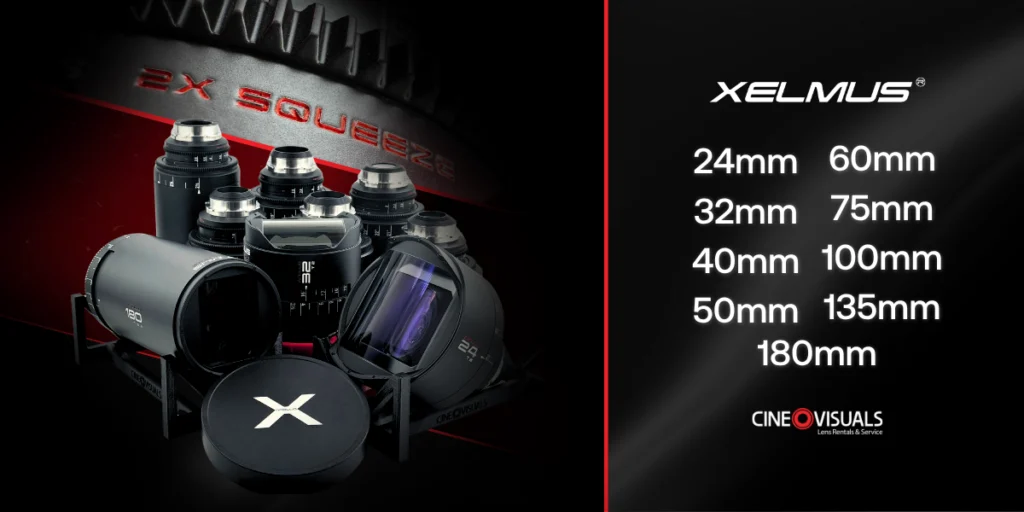
Image Fidelity & Focus
Characteristic of anamorphic lenses, the Xelmus Apollo Anamorphics are dreamy and impressionistic. A gentle bending on each edge of the frame to create a horizontal stretch adds that touch of wonder that anamorphic glass is so beloved for. Center sharpness with strong focus falloff from the center in a horizontal oval creates a natural frame for the subject. With painterly strokes, the lenses bring a feeling of the style of paintings so popular in the late 19th and early 20th century. Experimental, pushing the bounds of realism by capturing the feeling subjectively with a personal memory over the clinical objective beauty of pure accuracy. The lenses, while true to the world, add that touch that made them so popular in the mid to late 20th century and beyond.
Wide open, halation is strong, with a dreamy feeling that feels like a twist on Bronze Glimmerglass. Closed down a stop or two, the image sharpens quickly giving the cinematographer flexibility and control over the level of expression they need. Skin tones are handled with warmth and grace, but are a bit sharper than vintage anamorphics. Giving them a filmic quality, optics add a bit of warmth into the highlights and midtones while the shadows have a touch of coolness. Many modern anamorphics attempt to hide many of the traditional qualities of vintage glass. While technically aberrations, many cinematographers consider these optical imperfections as providing a gentle and organic quality to the glass. Xelmus, started by cinematographers rather than optical technicians, understood this. They wanted to strike a balance between the creative and technical needs of an image. Sharp, but not clinical. Flares with total control. The Apollos match this, striking a nice balance between the extreme qualities of vintage anamorphics such as the Kowa Cine Prominar Anamorphics and the higher contrast and cleaner image of ARRI Zeiss Master Anamorphics. Beautiful glass that brings an organic feeling to the project.
Handling & Adaptability
For anamorphic lenses, each focal length is relatively lightweight for what it seeks to achieve. Spanning the set, the lenses weigh between 3.88 lbs and 6.52 lbs. Many spherical lenses weigh at least this much. For anamorphics that are traditionally much heavier optics than sphericals these weights are quite impressive. Across the line there are three different front diameters. The 24mm has the largest in the set with a front diameter of 136mm while the 32mm and 40mm have a front diameter of 114mm. From 50mm-180mm, the front diameter of each of these six focal lengths is 104mm. For a full set of Xelmus Apollo Anamorphics, the entire line has only three separate front diameters, with two of them living in the wide angle end of the span. For on-set efficiency, this gives an ergonomic workflow for filmmakers. Filter changes, lens swaps, and other camera adjustments are easier when the front diameter of the lenses match across the set. Each lens has standard 0.8 MOD buttery smooth rings with 270º focus rotation. Focus pulling will be precise and accurate with this long rotation. Something standard of modern housing but rare in vintage housing, focus motors can remain in the same place during lens swaps with focus rings in the same spot.
Image Circle
Sensor and image plane coverage is truly incredible in the Xelmus Apollo Anamorphics. With the exception of the 24mm and 32mm, every focal length easily covers Full Frame. Yet, what may be even more impressive is that the longer focal lengths can even cover 65mm and medium format cameras. Specifically, each focal length has these image circles:
24mm – 33.97mm
32mm – 39.05mm
40mm – 49.58mm
50mm – 49.58mm
60mm – 56.73mm
75mm – 68.01mm
100mm – 81.41mm
135mm – 84.20mm
180mm – 98.89mm
In order to cover traditional Super 35mm film, a minimum image circle of 31.1mm is required, which every focal length in this set easily covers and the 24mm and 32mm are best at. For Full Frame, an image circle of 43.3mm is required, for cameras like the ARRI Alexa Mini LF or Sony Venice which have 44.7mm and 43.5mm diagonal image plane coverage on their sensors respectively. VistaVision, which is horizontally exposed 8-Perf 35mm film for which digital Full Frame sensors draw their inspiration, the image circle is 45.5mm. For high-end Full Frame cinema, this is the standard and all of these lenses easily cover these.
Now, the really impressive feat of the Apollo Anamorphics are their ability to project with ease onto medium format and 65mm image planes. The Fujifilm Eterna 55 (available for rent here at Cine Visuals) which has an image circle of 54.5mm, pairs incredibly with the Apollos. Every focal length 60mm and above easily covers this plane. That means, the 60mm, 75mm, 100mm, 135mmm, and 180mm focal lengths together can all be easily used as a set to pair with the Fujifilm Eterna 55.
For anamorphics, three lengths is typical for a set so to have five that can be used with the brand-new Eterna 55 makes for an exciting spectacle. For 65mm film the image circle that needs to be covered is 57mm while the ARRI Alexa 65 needs an image circle of 59.86mm. In the same way as for the Fujifilm Eterna 55, the 60mm nearly covers this area with the 75mm, 100mm, 135mm, and 180mm all easily covering this area. And finally, the largest format to date, 15-Perf horizontally exposed 65mm IMAX film has an image circle of 84.83mm. Impressively, the 135mm nearly covers this entire area with only very slight vignetting that can be added as a creative touch or easily cropped. The 180mm has an image circle that more than covers the IMAX image circle. For a lens like the Xelmus Apollo Anamorphics to be able to cover the huge format of IMAX film is truly incredible, all with a native 2x squeeze. The 135mm and 180mm combined with IMAX film and a 2x squeeze would project an unbelievable image. Beautiful and impressive.
Flare & Bokeh
One of the many reasons cinematographers choose anamorphic lenses are for their flares and bokeh. Perhaps, this may be one of the most striking characteristics of anamorphic glass. The Xelmus Apollo Anamorphics are no different and in fact enhance and breathe new life into this look. Classic astigmatism flares spread across the frame. With cooler tones, these flares have a blue appearance with white lights, but will take on the color of their light source with a cooler edge. Wide open, flaring creates a horizontal oval around the edges, reminiscent of vintage anamorphics. Immediately around the light source is a gradual falloff of warm halation that is bisected by the blue and purple streaks. When light sources peak around at the edge of the frame, a gentle ovular rainbow bends across the image. Bokeh adds a painterly appearance for the background. Typical of anamorphic glass, long ovals create the bokeh with strong swirling on the edges creating an impressionistic feeling when wide open, recalling the late 19th century impressionists. However, stopped down some of the more extreme features of the lenses neutralize and sharpen for a cleaner appearance when needed. Beautiful and versatile modern anamorphic glass.
These lenses are available for rent at Cine Visuals. For inquiries or testing appointments email info@cinevisuals.com or call (323) 244-2552.