
Loading cart...

Atlas Mercury Anamorphics: Bringing Atlas to Full Frame
Atlas Lens Co. & Cine Visuals Present: Atlas Mercury
Cinematic Heritage
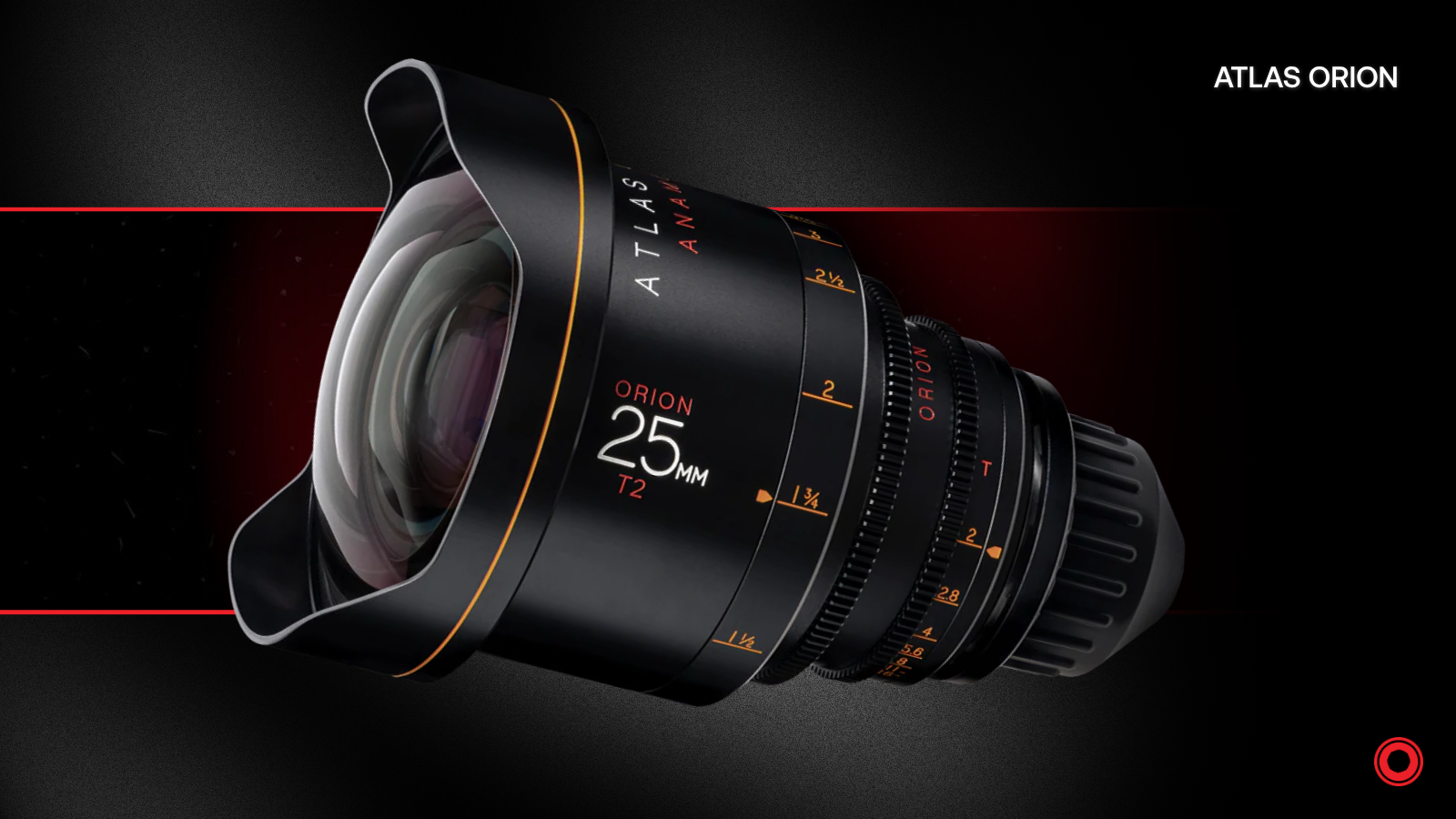
When Atlas Lens Co. first stepped into the industry spotlight with the Atlas Orion Anamorphic, the mission was clear: bring the classic 2x CinemaScope look back into reach for working cinematographers. Founders Dan Kanes and Forrest Schultz built their reputation by designing lenses that honored the expressive character of vintage glass while solving the real-world frustrations of modern production.
But as digital cinematography evolved – and Full Frame sensors became increasingly common – a new question emerged. The Orions were designed around S35mm coverage and a traditional 2x squeeze. They delivered sweeping, classic anamorphic frames, but large-format capture was quickly becoming the new normal. Cinematographers wanted more sensor coverage, more flexibility in aspect ratios, lighter builds for gimbal and handheld use, and a look that still felt unmistakably anamorphic without requiring heavy cropping or oversized glass. That’s where the Atlas Mercury Anamorphic series was born.
Introduced in the early 2020s, the Mercury line was conceived as a modern evolution – not a replacement – of the Orion philosophy. Instead of 2x, Atlas chose a 1.5x front anamorphic element. That decision was deliberate. A 1.5x squeeze gives cinematographers tremendous flexibility across 16:9, 3:2, and 4:3 Full Frame sensors, enabling aspect ratios like 2.39:1, 2.25:1, and 2.66:1 without extreme cropping. It also allows for a slightly more natural facial rendering compared to aggressive 2x compression.
Orion was Atlas proving that anamorphic could be accessible again. Mercury was Atlas adapting that dream for the large-format digital era – lighter, broader in coverage, and tuned for contemporary workflows.

Image Fidelity & Focus
The Mercury lenses carry clear ancestral DNA from the Orions, but the rendering shifts in subtle and important ways. Wide open at T2.2, the Mercurys are clean yet expressive. Contrast is moderate – not overly punchy – allowing highlights to bloom gently rather than snap harshly into clipping. Skin tones are consistently described by cinematographers as warm, dimensional, and forgiving. There’s a golden bias to the color response that pairs beautifully with natural light and tungsten sources, giving faces a richness without veering into oversaturation.
Sharpness is modern but not clinical. Center fidelity is strong and dependable across the set, while edges fall away with a controlled softness that feels intentional rather than accidental. Stop down to T2.8 or T4 and detail tightens noticeably, especially on high-resolution full frame sensors, yet the lenses never lose their organic texture.
One of the more appreciated characteristics is how the Mercurys handle tonal separation. Shadows tend to maintain density without muddying. Mid-tones – particularly skin – hold a creamy smoothness. Highlights retain a subtle warmth, and flare contamination is controlled enough that contrast rarely collapses unintentionally. Chromatic aberration is notably well managed for an anamorphic design, and focus breathing is minimal, supporting narrative-driven focus pulls without distraction.
Compared to older, more unpredictable vintage glass, the Mercurys feel refined. Wide open, the fall-off into defocus feels gradual and cinematic, contributing to dimensional subject separation without overwhelming the frame. Compared to ultra-modern anamorphics designed for maximum sharpness and minimal character, they feel alive. There is gentle vignetting at wider apertures, especially on broader focal lengths, but it reads as atmospheric rather than mechanical. Combined with the subtle barrel distortion present on some wider lenses, the Mercurys carry a sense of spatial character that feels organic and immersive.They sit in a carefully chosen middle ground – expressive but disciplined.
Handling & Adaptability
Physically, the Mercury series was engineered with modern set realities in mind. Most focal lengths share a 95mm front diameter (with the 24mm expanding to 114mm), making matte box swaps quick and consistent. Focus and iris gears are standard 0.8 pitch, and the focus rotation is long enough to give camera assistants precision without feeling excessive. The housing design keeps gear positions largely unified across the set, so lens changes don’t require a full reconfiguration of motors and accessories.
Weight is one of Mercury’s defining strengths. Depending on focal length, lenses range roughly from 2.30 lbs on shorter mid-range focal lengths to about 4.70 lbs on the longest 138mm. Lengths generally sit between approximately 4.40 inches and 8.10 inches. For full-frame anamorphic primes, that’s impressively compact.
On a studio build, they feel balanced. On handheld, they don’t pull aggressively front-heavy. On gimbals and Steadicam, they’re far more manageable than traditional large-format 2x anamorphics. That portability was intentional – Atlas designed Mercury knowing that cinematography now spans drones, car rigs, compact bodies, and stripped-down builds.
Standard mount is PL, but interchangeable mounts (including EF, Sony E, and RF) broaden compatibility across ARRI, RED, Sony, and Canon systems. The adaptability reinforces the core idea: anamorphic shouldn’t be reserved only for massive studio packages.
Image Circle
Unlike the Orion series, which was designed around a S35mm image circle (approximately 31mm), the Mercury lenses were built for Full Frame coverage. They cover roughly a 36.7mm x 25.54mm image area, supporting modern large-format digital sensors without vignetting in standard full-frame modes. That’s a diagonal image circle of 44.71mm. Typically, a 43.3mm diagonal circle is the minimum for coverage of Full Frame, which the Mercury lenses easily cover. The 1.5x squeeze plays beautifully with this expanded sensor real estate. Instead of forcing extreme aspect ratios, the Mercurys allow cinematographers to choose how wide they want to go.
Flare & Bokeh
Anamorphic lenses are often judged first by two traits, expressive flares and ovular bokeh. Mercury delivers both. Instead of the pronounced blue streaks associated with many 2x anamorphics (including the Orion line), Mercury’s flares tend toward a warmer, golden hue. They streak horizontally, as expected, but feel slightly more restrained and easier to control. They rarely wash out the entire frame unless intentionally provoked. The flare character complements skin tones rather than fighting them. Bokeh is oval, as dictated by the 1.5x squeeze, but slightly less exaggerated than traditional 2x glass. Out-of-focus highlights stretch vertically with a smooth, painterly quality. The 14-blade iris design helps maintain roundness when stopped down, preventing harsh geometric shapes.
These lenses are available for rent at Cine Visuals. For inquiries or testing appointments email info@cinevisuals.com or call (323) 244-2552.