

Loading cart...

Cooke S8/i Primes: Cooke Look for the Digital Era
Cooke & Cine Visuals Present: Cooke S8/i Primes
Cinematic Heritage
To understand the Cooke S8/i FF, one must first understand that Cooke is not merely a lens manufacturer but a visual philosophy that has evolved alongside cinema itself. Founded in 1893 in Leicester, England, and shaped by the optical innovations of figures such as Horace W. Lee, Cooke Optics became one of the defining contributors to motion picture imagery in the twentieth century. The original Cooke Panchros of the late 1920s were engineered at a moment of enormous technological upheaval. Panchromatic film stocks were expanding tonal sensitivity across the visible spectrum, and the transition from silent cinema to sound demanded new lighting strategies and faster lenses. Rather than simply correcting optical flaws, Cooke lenses began to shape a signature rendering with natural skin tones, a gentle warmth, subtle aberrations, and a fall-off that felt organic rather than mechanical. What became known as the “Cooke Look” was not just a marketing invention; it was a response to evolving cinematic needs, and it embedded emotion into optical science.
As decades progressed, Cooke continued refining that identity through successive generations of primes, from Speed Panchros to the S4/i and S7/i Full Frame lenses. Each era brought new technical demands. The rise of digital cinematography in the early twenty-first century intensified resolution and contrast, while large-format sensors expanded the image plane beyond the traditional S35mm standard. Cameras such as the ARRI Alexa Mini LF, the Sony Venice, and the RED Raptor VV introduced expansive sensors capable of extraordinary clarity. Yet with that precision came a recurring concern among cinematographers – images risked becoming too pristine, too clinical, and too detached from the tactile quality that defined photochemical cinema.
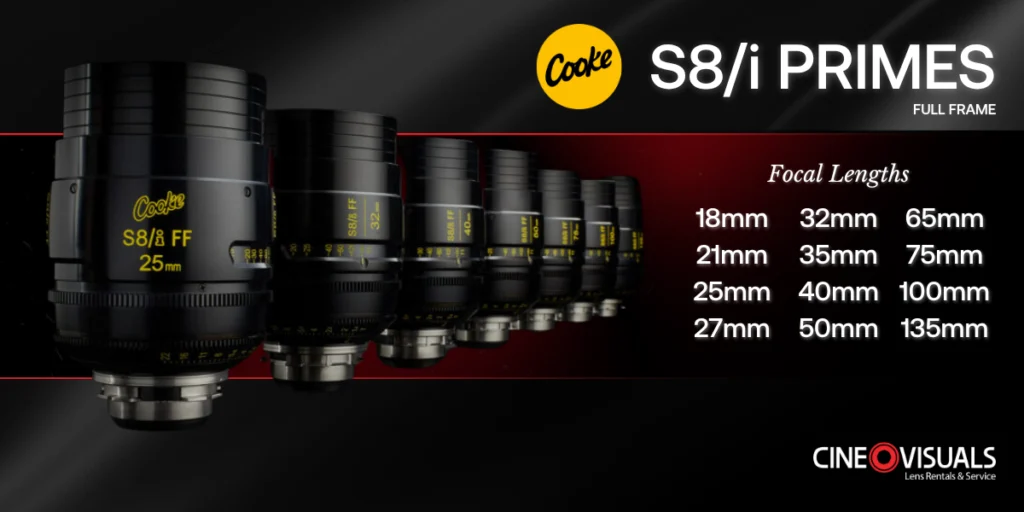
The S8/i FF series, announced in 2022, emerged as Cooke’s answer to this moment. Designed under the guidance of Chief Optics Advisor Iain Neil, the S8/i lenses were not a nostalgic recreation of vintage glass, nor merely an extension of the S7/i line. They were conceived from the ground up as fast, large-format spherical primes capable of resolving modern sensors while preserving dimensionality and warmth. With a uniform T1.4 aperture across the set and focal lengths spanning 18mm through 135mm, the S8/i series reflects Cooke’s long-standing habit of listening carefully to cinematographers and responding with purpose-built tools rather than incremental updates.
Image Fidelity & Focus
When open to T1.4, the sensation of the S8/i lenses is not merely increased exposure but an expansion of atmosphere. Resolution is undeniably high, capable of meeting the demands of large format capture, yet the sharpness does not feel brittle or unforgiving. Instead, there is a nuanced balance between crisp central detail and a graceful, almost imperceptible roll-off toward the edges. This rendering sustains what many cinematographers describe as dimensionality. Subjects feel grounded in space rather than pasted onto a hyper-detailed backdrop.
The traditional Cooke Look is evident here, though refined for contemporary expectations. Skin tones maintain warmth without veering into exaggeration. Contrast is confident but never aggressive, allowing highlights to roll off smoothly while retaining depth in shadows. Focus transitions are fluid. There is no abrupt cliff where clarity ends and blur begins; rather, the image transitions in layers, creating a painterly separation that supports narrative rather than distracting from it.
The optical design is engineered to be near-telecentric, optimizing the angle at which light strikes digital sensors. This improves color consistency across the frame and reduces chromatic aberrations that can become distracting at large image scales. Yet Cooke has never pursued sterility for its own sake. Subtle aberrations remain, carefully tuned so that the image feels alive. Micro-contrast contributes to texture without accentuating harshness. Even wide open, the lenses avoid the flat, overly corrected quality that sometimes accompanies modern large-format primes. Instead, they maintain a cohesion that recalls the photochemical era while embracing digital precision. In practice, cinematographers often describe the S8/i as modern but soulful. It is this careful equilibrium between fidelity and feeling that defines their character.
Handling & Adaptability
Large-format lenses at T1.4 inherently demand complex optical construction, yet the physical experience of working with the S8/i series is intentionally straightforward. Most focal lengths share a consistent 104mm front diameter and closely matched barrel dimensions, enabling streamlined mattebox configurations and efficient lens changes. The wider focal lengths, with their larger front elements, remain balanced in proportion to their optical requirements. Focus rotation extends to 270º, offering assistants precise and repeatable marks, while the nine-blade iris preserves circular aperture geometry throughout much of the stop range.
Cooke’s /i³ technology is integrated seamlessly into the mechanical design. This metadata system transmits detailed lens information including focus distance, aperture, and distortion characteristics directly to compatible cameras and recording systems. In contemporary workflows where visual effects, virtual production, and advanced color grading rely on precise data, this embedded communication simplifies post-production processes without burdening on-set operation.
The housings themselves are robust but refined. Weights vary depending on focal length, yet remain manageable for large-format primes of this speed. On tripod, dolly, or stabilized systems, the lenses feel secure and well-balanced. Even in handheld configurations, they avoid excessive front-heaviness, maintaining ergonomic stability. The sophistication of the internal mechanics dissolves into intuitive usability. The complexity exists within the glass – on the outside, everything is deliberate and predictable.
Image Circle
The S8/i series is engineered around a 46.3mm diagonal image circle, with the widest focal lengths optimized closer to the traditional Full Frame diagonal of 43.3mm. This distinction may seem minor numerically, yet it represents a substantial expansion compared to S35mm, whose necessary diagonal image circle typically measures around 28 to 31 millimeters depending on gate and crop.
Full Frame digital sensors require a 43.3mm diagonal image circle. VistaVision, a horizontal 35mm film format introduced in the 1950s based on still photography 8-Perf 35mm exposure, expanded the negative area further, offering greater resolution and field of view. Modern large-format digital cameras often mirror or exceed these dimensions. The ARRI Alexa Mini LF operates with an Open Gate diagonal of approximately 44.7mm. The Sony Venice and the RED Raptor similarly employ expansive sensors approaching or exceeding traditional Full Frame coverage.
By designing the S8/i lenses to exceed the minimum Full Frame requirement, Cooke ensures reliable coverage without vignetting and preserves consistent optical character across the entire image area. This expanded coverage influences more than framing flexibility. It alters spatial relationships, depth-of-field behavior, and environmental context. At equivalent fields of view, large-format capture produces shallower depth of field and a distinct sense of scale. The S8/i primes were conceived to maintain their warmth and dimensional rendering even as the image plane expands, preserving emotional intimacy within grander compositions.
Flare & Bokeh
Flare and bokeh often reveal a lens’s true personality, and here the S8/i lenses express Cooke’s modern sensibility. The coatings are carefully calibrated to maintain neutrality while allowing expressive response when light strikes the front element. Flares emerge with restraint. Highlights bloom softly, often presenting as clean white halos that carry a subtle warmth depending on the source. Contrast gently lowers rather than collapsing entirely, preserving image structure while introducing atmosphere. Unlike certain earlier Cooke designs known for more pronounced color artifacts, the S8/i flare signature is controlled and refined. It feels intentional, contemporary, and balanced. The goal is not spectacle but elegance. Bokeh is equally considered. The nine-blade iris maintains roundness through much of the stop range, producing circular highlights that remain full and dimensional. Wide open at T1.4, out-of-focus areas melt with a creamy smoothness. When closed down, the bokeh begins to take on a muted octagonal bokeh, reminiscent of the classic Cooke S4s. From edge-to-edge of the frame the bokeh maintain their shape without any comatic aberration, crescenting, or cat-eye shape changes. There is no harsh outlining or nervous shimmer. The background separation feels layered and immersive.
These lenses are available for rent at Cine Visuals. For inquiries or testing appointments email info@cinevisuals.com or call (323) 244-2552.