

Loading cart...

Leitz Summilux-C: Leica Enters Motion Pictures
Leitz & Cine Visuals Present: Leitz Summilux-C
Cinematic Heritage
In the mid-19th century, the German city of Wetzlar became home to a precision optical workshop that would eventually shape the entire visual culture of photography, a budding science and art at the time. Ernst Leitz inherited and expanded a small optical institute that specialized in microscopes and scientific instruments. He named his little operation Leica. The company’s reputation grew through the meticulous grinding of glass and a dedication to mechanical craftsmanship. Precision optics were not simply a product but a philosophy. Every instrument leaving the factory reflected an obsession with clarity, reliability, and thoughtful design. Decades later into the early 20th century, one of Leica’s engineers, Oskar Barnack, began experimenting with a small camera that used 35mm motion picture film exposed horizontally. His goal was simple. He wanted to create a portable camera capable of producing professional quality photographs without the heavy plate systems that dominated the era. The result was the Leica camera. When it debuted in 1925 it revolutionized photography. Suddenly photographers could carry a compact camera capable of extraordinary image quality for the time anywhere in the world. The Leica system became synonymous with documentary photography, journalism, and artistic exploration. War correspondents, explorers, and street photographers all carried Leica cameras because they trusted the lenses and the mechanics.
As Leica evolved, its lenses developed distinct families that photographers came to know intimately. Each name reflected a different optical philosophy tied to aperture and rendering. The Noctilux series represented the pursuit of light itself. These lenses pushed the limits of optical design with enormous apertures that could capture images with limited light while producing an unmistakably dreamy depth of field – often living in the sub-f0.95 region. The Summilux line balanced speed and precision at f1.4 and became beloved for its luminous rendering and graceful contrast. Summicron lenses followed with f2 apertures and a reputation for impeccable sharpness paired with gentle tonal transitions. The Elmarit family provided a slightly slower f2.8 design that emphasized compactness, reliability, and accessibility without sacrificing optical quality.
The Elmar lenses traced their heritage back to some of Leica’s earliest optics and represented elegant simplicity with modest apertures and beautiful color reproduction.
For decades cinematographers quietly borrowed from this optical tradition. Companies like Canon were founded to be in direct competition with Leica’s photography supremacy at the time. Leica still photography lenses were frequently rehoused for cinema because filmmakers admired the natural color and dimensionality they produced. Yet these adaptations were never purpose built cinema tools. Focus rotation was short and the mechanics were not designed for the rigors of a film set. Recognizing the growing demand for dedicated cinema optics that preserved Leica’s visual character, the company eventually created a specialized branch devoted entirely to motion picture lenses. This division was named Leitz in honor of the company’s founder. Leica would continue to focus on still photography while Leitz would translate that optical heritage into housings designed specifically for filmmaking.
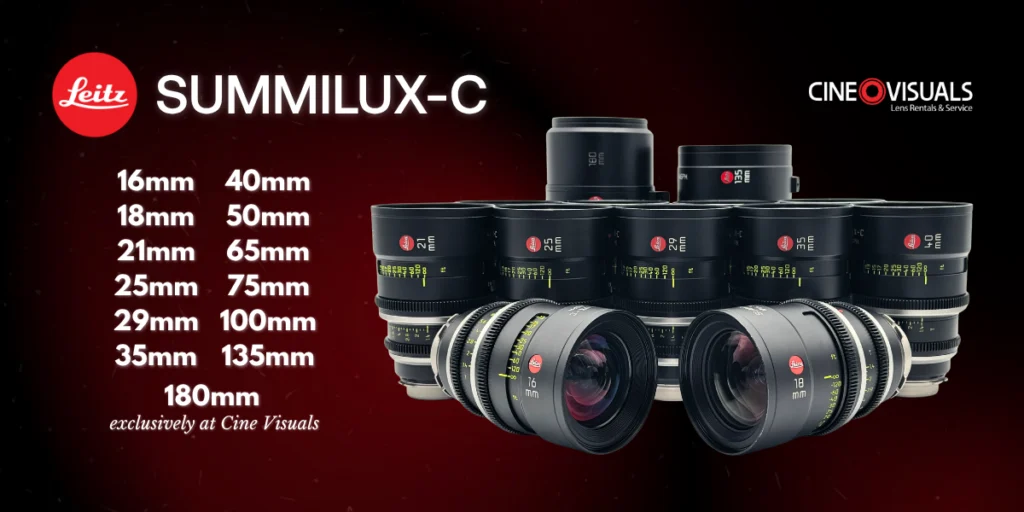
The Summilux-C lenses emerged from this philosophy. Developed by a team of optical engineers in Wetzlar, the project sought to capture the aesthetic essence of Leica’s legendary Summilux photography lenses while designing an entirely new optical architecture suitable for motion picture cameras. Before this, Leica lenses had only ever been rehoused from still photography by third-parties. This was Leica’s true emergence into the motion picture realm. These lenses were not simply adaptations of still lenses. They were purpose built cinema optics designed for digital sensors and professional workflows. The goal was ambitious. Create a full set of T1.4 cinema primes that were compact, mechanically consistent, and capable of delivering the smooth and elegant image quality that photographers had admired in Leica glass for generations. When the Leitz Summilux-C series was introduced it represented Leica’s most serious entry into the world of cinema optics. The lenses immediately stood apart from many contemporary cinema primes which were often large and heavy. Instead the Summilux-C lenses carried a sense of precision and refinement that felt unmistakably Leica. They delivered the speed of a T1.4 aperture across the entire set while maintaining manageable size and exceptional optical performance. In many ways they represent the modern continuation of the Summilux philosophy. Fast, precise, and artistically expressive.
Image Fidelity & Focus
Looking through a Summilux-C lens reveals an image that feels unmistakably Leica. There is an elegance to the way these lenses capture light that has been refined through generations of optical design. The frame appears clean and detailed without feeling clinical or harsh. Resolution is strong from the center outward, yet the image retains a softness in tonal transitions that keeps the picture feeling natural rather than overly analytical. At the center of the frame, subjects appear crisp and confident. Fine textures resolve beautifully while still maintaining a gentle contrast that flatters skin and organic surfaces. Modern digital sensors can often exaggerate detail in a way that feels brittle or unforgiving. The Summilux-C lenses temper this behavior with a smoother tonal response. Highlights roll off gradually while shadows maintain depth without crushing subtle information. This balance creates an image that feels cinematic even when paired with the most advanced digital cameras. Color rendition is perhaps where the Leica heritage becomes most visible. The lenses deliver a neutral palette that avoids the exaggerated saturation found in some modern optics. Instead the colors appear balanced and harmonious. Skin tones carry a natural warmth without drifting into orange or red exaggeration. Cooler hues remain stable and controlled, allowing blues and greens to maintain richness without overwhelming the scene. The overall effect is smooth and creamy yet grounded in realism.
Focus falloff plays a significant role in shaping the visual character of the Summilux-C lenses. As subjects move away from the plane of focus the transition into blur occurs gradually rather than abruptly. The image gently melts into softness while preserving shape and color. This creates a dimensional quality that subtly draws the viewer’s attention toward the subject. Even when the lenses are used wide open at T1.4 they maintain remarkable composure. The image does not become milky or overly soft. Instead it retains clarity with just enough spherical character to create depth and atmosphere. Leica engineers carefully balanced aberration correction so that the lenses avoid the sterile perfection sometimes associated with modern cinema optics. The image remains controlled but never lifeless. There is always a sense of gentle motion in the way focus transitions and light moves across the frame. This balance between clarity and character is ultimately what defines the Summilux-C image. The lenses are technically precise yet artistically expressive. They produce images that feel smooth, luminous, and emotionally resonant without sacrificing the sharpness required for contemporary cinema production.
Handling & Adaptability
While the optical performance of the Summilux-C lenses often receives the most attention, their mechanical design is equally impressive. Leitz engineered the series with a clear understanding of the practical realities of film production. Every lens in the set shares a consistent physical architecture that allows camera operators and assistants to work efficiently during demanding shooting schedules. The majority of the lenses feature a front diameter of 95mm. This consistency simplifies matte box adjustments and allows filters to remain in place when switching focal lengths. Most focal lengths measure about 5.50 inches in length and weigh between 3 to 4 lbs. This balance makes them suitable for a wide range of camera configurations from large studio rigs to more compact handheld setups. The mechanical housings are constructed from durable materials that maintain precision even under the stress of professional production environments. These small details may appear subtle but they significantly improve workflow on a busy set.
Focus rotation is generous and precise, allowing 1st ACs to pull focus smoothly even when working at the shallow depth-of-field produced by a T1.4 aperture. Gear positions for focus and iris are similarly consistent throughout the set which minimizes the need to reposition motors or follow focus units. The internal focusing mechanisms are engineered to minimize breathing so that the frame remains stable during focus pulls. This stability is particularly important for dramatic storytelling where subtle focus transitions guide the audience’s attention. Despite their fast aperture the lenses remain relatively compact compared with many other extremely fast cinema primes. Close focus distances allow cinematographers to bring subjects surprisingly near to the lens which enhances the intimacy of many shots. The lenses also maintain a consistent T1.4 aperture across nearly the entire set from wide angle through telephoto which gives filmmakers enormous flexibility and consistency.
Image Circle
The Summilux-C lenses were designed around the S35 motion picture format. S35 evolved from traditional 35mm film cameras which originally exposed a smaller frame that left space for optical sound on the film strip. Engineers eventually realized that this unused area could be reclaimed for picture information, once sound recording no longer needed that area. By expanding the exposed region filmmakers created a larger frame measuring roughly 24.9mm x 18.6mm with a diagonal of 31.1mm. This format became known as S35 and it quickly became the dominant standard for cinema production.
Modern digital cameras often mirror this format because it provides an ideal balance between image quality, familiarity, and lens options. The Summilux-C lenses therefore produce an image circle of 33mm which comfortably covers the S35 frame and maintains strong performance across the entire image. This design ensures that cinematographers can use the lenses on a wide range of S35 digital cinema cameras.
Flare & Bokeh
Leitz applied advanced multi-layer coatings to the glass elements of the Summilux-C which carefully control internal reflections. These coatings suppress excessive glare while still allowing subtle flares to appear when bright sources enter the frame. When a strong point light source strikes the lens the flares tend to appear as soft circular reflections that move gracefully across the image. Their color often carries a delicate balance between cool blue and faint green tones depending on the angle of the light. Highlights bloom gently rather than exploding into harsh glare. This restrained behavior allows cinematographers to work confidently with practical lights or sunlight entering the frame. The lens responds in a way that enhances the atmosphere of the scene without distracting the viewer.
The iris design creates smooth circular bokeh that maintain their shape across much of the frame. When used wide open the background dissolves into a creamy field of color and light. These defocused highlights feel soft and dimensional rather than nervous or chaotic. Toward the edges of the frame the bokeh stretches slightly forming gentle elliptical highlights that add motion and depth to the background. Importantly the lenses maintain strong control over comatic aberration so these highlights remain clean and orderly rather than smeared or distorted. The result is a background blur that feels smooth and organic while preserving the overall elegance of the image.
These lenses are available for rent at Cine Visuals. For inquiries or testing appointments email info@cinevisuals.com or call (323) 244-2552.