
Loading cart...

Cooke Mini S4/i: Compact Cookes, Classic Character
Cooke & Cine Visuals Present: Cooke Mini S4/i Primes
Cinematic Heritage
Cooke Optics has been shaping the visual language of cinema for well over a century. Founded in Leicester, England in 1893, the company emerged during a period when optical science was rapidly evolving alongside the earliest motion picture technologies. From its earliest days Cooke engineers understood that lenses were not merely technical devices designed to resolve detail. They were instruments capable of shaping the emotional quality of an image. Among the most influential figures in this philosophy was Horace W. Lee, whose work would ultimately define the aesthetic character that filmmakers now refer to as the Cooke Look.
Lee’s most important contribution arrived in the late 1920s with the introduction of the Cooke Panchro lenses. At the time the motion picture industry was transitioning away from orthochromatic film stocks. Orthochromatic emulsions were primarily sensitive to blue and green wavelengths of light and were largely blind to red tones. This limitation meant that skin without any make-up could appear in odd ways and certain colors rendered unpredictably. When Eastman Kodak began producing panchromatic film on a wider scale, the new stocks responded to the entire visible spectrum. Suddenly the camera could capture reds and subtle tonal variations that had previously been invisible. Yet this improvement exposed a new problem. Optical flaws that had once been hidden by orthochromatic film became immediately apparent. Chromatic aberrations and uncontrolled flaring were far more noticeable when the full color spectrum was recorded.
Lee responded by redesigning the Cooke optical formula to better control these aberrations while preserving a gentle and natural rendering of faces. Introduced in 1927, the Cooke Panchro lenses balanced resolution with warmth and graceful focus falloff. Cinematographers quickly embraced them for their ability to render skin tones with remarkable naturalism. These lenses would dominate Hollywood cinematography for decades, evolving through generations such as the Speed Panchros and Super Speed Panchros. Their visual signature eventually became known simply as the Cooke Look. It was not defined by absolute optical perfection but by a deliberate balance between precision and personality.
By the late 20th century cinema optics had entered a new technological era. Computer aided design and modern glass manufacturing allowed lens engineers to pursue extreme sharpness and optical correction. While these advancements produced highly precise lenses, many cinematographers began to feel that images were becoming too clinical. Cooke recognized that filmmakers still valued the emotional rendering that earlier lenses provided. In the late ‘90s the company introduced the Cooke S4 Prime series as a modern reinterpretation of their historic visual philosophy.
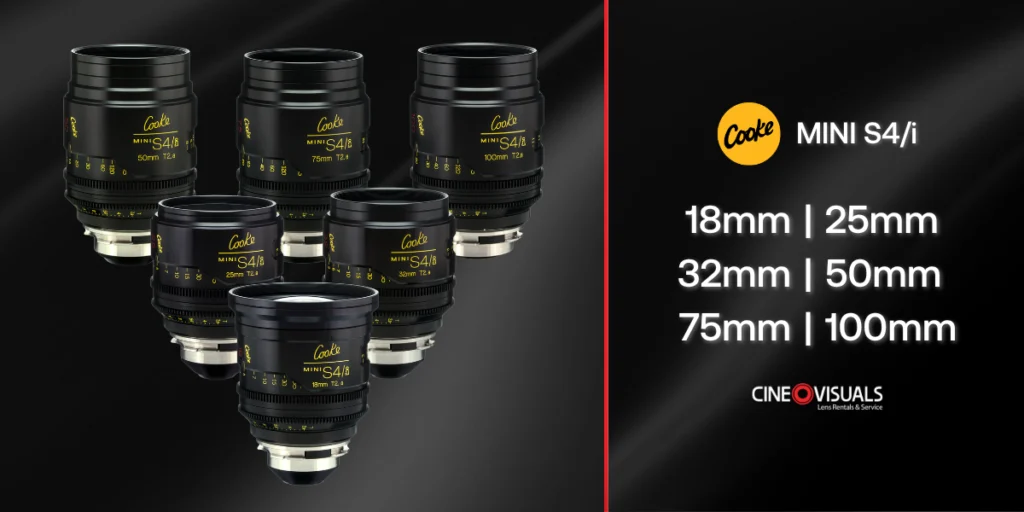
The S4 lenses were engineered specifically for Super 35 motion picture film and offer exceptional consistency across the set with a fast T2 aperture. More importantly they preserved the warmth and dimensional focus behavior that had defined Cooke lenses for generations. The S4 primes quickly became one of the most widely respected lens families in contemporary filmmaking. As digital cinematography expanded into more mobile production styles, cinematographers began looking for lenses that maintained this visual character while offering greater portability. Large prime lenses could be cumbersome for handheld work, Steadicam shots, and compact camera systems. Cooke responded by developing the Mini S4/i series. These lenses were designed to replicate the optical personality of the S4 primes in a smaller and lighter housing while remaining accessible to a wider range of productions. The tradeoff came in the form of a slightly slower T2.8 aperture, but the visual character remained remarkably close to their larger counterparts. The Mini S4/i lenses allowed filmmakers to carry the Cooke Look into more agile forms of cinematography without sacrificing the emotional qualities that have defined Cooke optics for nearly a century.
Image Fidelity & Focus
Looking through a Cooke Mini S4/i lens reveals an image that feels immediately familiar to cinematographers who have worked with traditional Cooke glass. Resolution is strong and modern, yet the image never feels brittle or overly corrected. The center of the frame carries a confident clarity while the edges soften ever so slightly, creating a subtle sense of dimensionality within the composition. Skin tones remain one of the defining strengths of the lenses – something the Cooke Look has always excelled at. Cooke optics have long been praised for their ability to render faces with warmth and natural color separation. The Mini S4/i lenses continue this tradition. Reds and oranges appear gently enriched while blues remain soft and restrained. This balance produces skin tones that feel lifelike rather than exaggerated. Faces carry a soft luminosity that preserves detail while maintaining a flattering appearance on screen.
Light moves through the optical design with a controlled elegance. Highlights roll off smoothly without clipping into harsh white. Shadows maintain depth without collapsing into dense contrast. The overall tonal response sits comfortably in the middle ground between vintage softness and modern clarity. This balance allows the lenses to complement both film stocks and high resolution digital sensors. The focus behavior contributes greatly to the emotional character of the image. Backgrounds soften with a creamy texture while the subject remains clearly defined. This transition creates a sense of depth that feels almost painterly. Subjects seem to exist within the environment rather than standing apart from it. This subtle interplay between resolution and softness has long been a hallmark of the Cooke Look. Aberrations are not eliminated entirely but carefully managed so that they contribute to the overall character of the image. The result is a picture that feels human and tactile.
Handling & Adaptability
While the optical personality of the Mini S4/i lenses carries the legacy of the S4 primes, their physical design reflects the practical demands of modern cinematography. The lenses were engineered to be significantly smaller and lighter than the original S4 series. Most focal lengths share a compact housing with an 87mm front diameter, while the wider 18mm expands slightly to accommodate its larger optical elements. Though, the lenses have a T2.8 instead of T2 like the S4/i lenses, which is a sacrifice made for their smaller form factor. However, this reduction in size makes a noticeably positive difference on set. Operators working with handheld rigs, Steadicam systems, or gimbal stabilizers benefit from the lighter weight and shorter barrel length. Camera balance becomes easier to maintain and lens changes can occur quickly without extensive reconfiguration of accessories. The lenses remain robust and professionally built, yet their compact proportions make them particularly well suited for agile camera movement.
Focus mechanics are equally refined. The lenses feature a long 300º focus rotation which allows focus pullers to perform precise and repeatable adjustments across the entire range of distances. The movement of the focus ring feels smooth and deliberate, providing tactile feedback that assistants rely on during complex shots. Markings remain clear and consistent across the set which simplifies the process of maintaining focus during moving scenes. Integrated within the mount is Cooke’s /i technology system. This electronic protocol allows the lens to communicate directly with compatible cameras. Information such as focal length, focus distance, and aperture is transmitted in real time and recorded alongside the captured image. For modern productions this metadata has become an invaluable resource. Visual effects artists can use the recorded information to recreate lens behavior during compositing, while colorists and editors can track lens characteristics throughout post production. The system effectively turns the lens into an intelligent component within the filmmaking pipeline, bridging the mechanical precision of traditional optics with the digital workflows of contemporary cinema.
Image Circle
The Cooke Mini S4/i lenses are designed specifically for the Super 35 format, a standard that has defined motion picture cinematography for decades. S35 evolved from Academy 35mm film by utilizing a larger portion of the negative area that was formerly used for optical sound. By extending the image across the full width of the film strip, S35 provided a wider field-of-view while maintaining compatibility with spherical lenses. To fully cover a S35 film frame the lens must project an image circle with a diagonal of 31.1mm. Modern digital cameras follow a similar standard. The ARRI Alexa Mini for example uses a sensor measuring roughly 28.17mm x 18.13mm which corresponds to a diagonal of about 33mm when in Open Gate mode. Lenses designed for S35 must comfortably exceed this measurement in order to ensure full coverage without vignetting. The Cooke Mini S4/i series produces an image circle of 33.54mm across the entire set. This consistent coverage ensures that each focal length performs reliably across the frame when used with S35 cameras and sensors, even in Open Gate mode.
Flare & Bokeh
Cooke’s optical coatings are designed to control internal reflections while still allowing the lens to respond gracefully to strong light sources. When bright light enters the frame the lenses produce flares that feel soft and atmospheric rather than aggressive. Highlights bloom gently into warm halos that lower contrast slightly without destroying detail within the image. Instead of overwhelming the frame the flare becomes a subtle visual element that enhances the atmosphere of the scene.
The bokeh carries its own distinctive character. At the center of this rendering is the eight blade iris diaphragm used throughout the series. When the lens is opened fully to T2.8 the aperture appears nearly circular and the out of focus highlights become smooth round shapes. Background elements melt away behind the subject with a creamy softness that enhances subject separation. As the aperture is closed the shape of the iris becomes more visible. The eight blade iris creates elegant octagonal bokeh within the background, a key feature of the original S4/i lenses passed down to the Mini S4/i lenses. Streetlights, reflections, and other bright points take on this subtle geometric form.
These lenses are available for rent at Cine Visuals. For inquiries or testing appointments email info@cinevisuals.com or call (323) 244-2552.