


Loading cart...

Angénieux Optimo Ultra Compact Zooms
Angénieux & Cine Visuals Present: Angénieux Optimo Ultra Compact Zooms
Cinematic Heritage
The story of the Angénieux brand begins long before the digital cinema revolution and long before large-format sensors became the industry standard. Founded in 1935 in Saint-Héand, France by the optical engineer Pierre Angénieux, the company was built on a foundation of precision optics, scientific rigor, and mechanical ingenuity. Pierre Angénieux was not simply a businessman entering the film industry; rather he was an optical designer deeply invested in solving problems that others had deemed impractical. From the outset, Angénieux lenses were known for advanced computation, meticulous assembly, and mechanical reliability.
Zoom lenses themselves predate Angénieux, with conceptual patents stretching back to the early twentieth century, but for decades they were regarded as optically inferior to prime lenses. Early zoom designs struggled with maintaining focus throughout the zoom range, suffered from dramatic exposure shifts, and lacked the sharpness required for professional cinematography. The breakthrough came when manufacturers began solving the problem of parfocality. A parfocal zoom maintains focus as the focal length changes, an essential requirement for narrative filmmaking. Pierre Angénieux and his engineering team were among the first to truly master this complex mechanical system.
In 1956, Angénieux introduced one of the first practical high-performance zoom lenses for 35mm cinema. It was not merely a technical novelty – it was a working cinematographer’s tool. The lens maintained focus through the zoom range and delivered an image quality that did not feel like a compromise. By the late 1950s and 1960s, Angénieux zooms were being used in documentary filmmaking, television production, and narrative features. Their flexibility allowed operators to adapt quickly to unfolding events without sacrificing visual integrity. Over time, Angénieux became synonymous with cine zoom design, carving out a specialization that remains central to the company’s identity.
As cinema transitioned into the digital age, new challenges emerged. Cameras such as the ARRI Alexa LF, ARRI Alexa Mini LF, RED Monstro 8K VV, and Sony Venice ushered in an era of cinematographers’ interest in large-format capture. These cameras featured significantly larger sensors than traditional S35mm, demanding lenses with expanded image circles and extremely high resolving power. Simultaneously, production workflows were evolving. Gimbals, drones, Steadicams, and handheld rigs became commonplace even on large-scale productions. Cinematographers wanted the flexibility of a zoom lens without the bulk traditionally associated with large-format optics. Angénieux responded by building on decades of experience. The company’s Optimo line had already proven that zooms could rival primes in clarity and color fidelity. But a new need had emerged – lightweight, large-format zooms capable of prime-like performance. The result was the Optimo Ultra Compact series. These lenses were conceived to bridge a specific gap in the film industry. They would offer Full Frame coverage, maintain a consistent T2.9 aperture, and remain compact enough for modern mobile production environments. In many ways, the Optimo Ultra Compact lenses represent the culmination of Angénieux’s seventy-year refinement of parfocal zoom engineering.
Image Fidelity & Focus
Zoom lenses inherently involve compromise. The complexity of multiple moving optical groups often introduces challenges in sharpness, distortion, and contrast consistency across the focal range. Angénieux approached the Optimo Ultra Compact series with the clear objective of eliminating the feeling of compromise. Cinematographers consistently describe these lenses as “prime-like,” a term not used lightly in an industry that reveres dedicated focal length glass.
Both lenses in the series maintain a constant T2.9 aperture across their focal ranges. This uniform transmission allows cinematographers to move fluidly through focal lengths without exposure shifts. More importantly, the lenses deliver strong center sharpness combined with remarkably consistent edge performance, even wide open. In large-format capture, edge integrity becomes increasingly important since the expanded sensor area exposes optical weaknesses that might go unnoticed on smaller formats. Focus mechanics are equally refined. Each lens offers 320º of focus rotation, providing assistants with precise, repeatable control. The focus falloff is smooth and organic rather than abrupt, creating a dimensional separation between subject and background that cinematographers often seek when shooting on large sensors. The transition from sharpness to defocus feels gradual and natural. Breathing is exceptionally well controlled, minimizing frame size shifts during focus pulls. For narrative filmmaking, where emotional emphasis often hinges on subtle rack focuses, this stability is critical.
Color rendition carries a subtle warmth that many cinematographers associate with the Angénieux signature. Skin tones are rendered with pleasing density and balance, and contrast remains firm without becoming overly clinical. While some modern lenses prioritize hyper-contrast and surgical clarity, the Optimo Ultra Compact series achieves a balance between resolution and character. This balance is one of the defining traits of Angénieux glass and a direct extension of its historical philosophy.
Handling & Adaptability
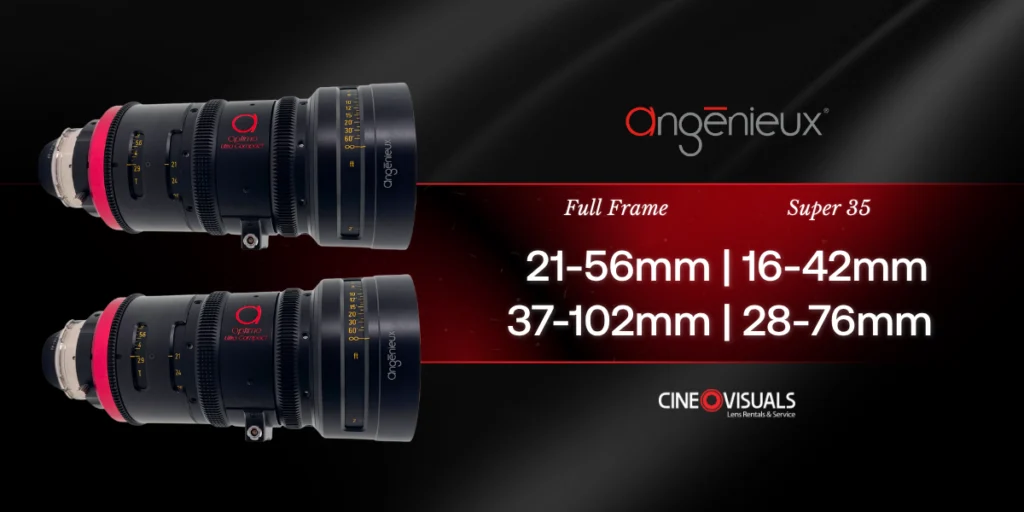
One of the defining achievements of the Optimo Ultra Compact series is the integration of large-format coverage into a compact physical form. Traditionally, Full Frame cine zooms have been heavy and cumbersome, limiting their usability on lightweight rigs. Angénieux designed these lenses specifically for adaptability. The Optimo Ultra Compact 21–56mm T2.9 weighs 5.70 pounds, and measures about 7.71 inches in length. Its sibling, the Optimo Ultra Compact 37–102mm T2.9, weighs approximately 6.40 pounds, with a length of about 8.90 inches. Both lenses share a 114-millimeter front diameter, ensuring compatibility with industry-standard matte boxes and accessories.
For camera operators, this size and weight profile makes a substantial difference. These lenses are balanced enough for handheld work and compact enough for gimbal configurations that would struggle under the load of larger zooms. For Steadicam operators, maintaining inertia and balance is critical. Unnecessary front weight can dramatically alter performance and therefore hinder the capture of the frame. The Ultra Compact series mitigates this issue while retaining mechanical durability. Camera assistants benefit from clearly spaced, consistent gear positions and the generous 320º focus throw. As is standard for cine-lenses, the lenses have excellent and smooth parfocal capabilities. Internal focusing mechanisms help maintain balance during operation, and the robust housing reflects Angénieux’s long-standing commitment to mechanical reliability. For cinematographers, adaptability extends beyond weight. The shared front diameter and similar ergonomic footprint between the two lenses allow for rapid lens swaps without extensive rig modifications, giving more time for the creative aspect of sets. In fast-paced production environments, this consistency translates into efficiency. The lenses feel purpose-built for contemporary workflows where time, mobility, and precision are equally valued. Handling and adaptability in the lens is precise, smooth, and incredible. These lenses could not be more efficient and ergonomic in their nature.
Image Circle
The rise of large-format digital cinema cameras dramatically shifted lens design priorities. Traditional S35mm lenses typically cover an image circle around 31 mm diagonally. The Optimo Ultra Compact lenses, by contrast, are designed with a diagonal image circle of approximately 46.3 mm. This expanded coverage allows them to fully illuminate Full Frame and VistaVision sensors without vignetting. On cameras such as the ARRI Alexa LF and Sony Venice, the larger image circle unlocks the aesthetic qualities associated with large-format cinematography. Wider fields of view at equivalent focal lengths create a sense of spatial immersion. Depth of field characteristics shift subtly, producing a distinctive separation between foreground and background elements. The ability to use a 21-56mm zoom across a Full Frame sensor, for example, provides expansive environmental framing while retaining subject intimacy. The benefits extend beyond aesthetics. Covering a larger image plane ensures edge performance remains strong even when shooting open-gate. The generous image circle also provides flexibility for stabilization in post-production, where minor reframing may occur without sacrificing resolution. Angénieux’s commitment to Full Frame coverage reflects its awareness of industry trends. As large-format capture becomes more prevalent in high-end television, streaming, and feature films, lenses must meet the demands of these expanded sensors without growing unwieldy. The Ultra Compact series achieves this balance, maintaining optical integrity across a broad image plane.
Flare & Bokeh
Flare behavior often reveals the character of a lens more than resolution charts ever could. The Optimo Ultra Compact lenses feature advanced multi-layer coatings designed to control stray light and minimize veiling flare. When bright sources enter the frame, the lenses maintain contrast while producing subtle, well-managed flare artifacts. Rather than overwhelming the image, flare appears restrained and cinematic. Highlights retain structure instead of blooming uncontrollably and are contained. Bokeh characteristics further reinforce the lenses’ balanced personality. The iris design produces smooth, rounded out-of-focus highlights. Background elements dissolve gently, contributing to a sense of depth without distracting from the subject. On large-format sensors, where shallow depth of field can become pronounced, this smooth rendering becomes especially important. The falloff toward defocus feels natural and cohesive, enhancing subject separation while maintaining a realistic spatial relationship.
These lenses are available for rent at Cine Visuals. For inquiries or testing appointments email info@cinevisuals.com or call (323) 244-2552.