



Loading cart...

Angénieux Optimo Ultra 12x: Optimal Versatility & Quality
Angénieux & Cine Visuals Present: Angénieux Optimo Ultra 12x
Cinematic Heritage
Nearly a century ago in a small town 45 miles (73 km) outside Lyon, optical engineer Pierre Angénieux founded what would become one of the most influential companies in cinema optics. Angénieux. Established in 1935 in Saint-Héand, the company did not begin as a film industry powerhouse. Instead, it was born from an engineer’s fascination with precision optics and a desire to push the limits of what lenses could do. Pierre Angénieux approached lens design with the mindset of a scientist rather than a manufacturer. At a time when optical formulas were calculated largely by hand, he implemented advanced computational techniques to predict the behavior of complex lens systems. His work helped accelerate the design process and allowed the company to explore ideas that many competitors considered too difficult or impractical. He was in it for the love of optics and experimentation, not only the business of capital. From the beginning, Angénieux lenses were characterized by two defining principles: mechanical ingenuity and optical elegance. These principles would soon converge in a field that was still in its infancy – zoom lens design.
In the early decades of motion picture production, cinematographers relied primarily on prime lenses mounted on rotating turrets. Changing focal lengths meant stopping the shot and physically swapping lenses (which is still commonplace today). Zoom lenses technically existed, but their image quality was inconsistent and their mechanics unreliable. Maintaining focus throughout the zoom range, a property known as parfocality, proved to be an extraordinarily difficult problem and one not yet solved on a viable basis. Pierre Angénieux became fascinated with this issue. His love for experimentation and drive for discovery led him and a team of engineers to take on this challenge head-on. After years of dedication, by the mid-1950s, the company introduced one of the first truly practical parfocal cine zoom lenses. This innovation reshaped cinematography. For the first time, camera operators could reframe within a shot smoothly and reliably without difficulty for focus pullers to remeasure and adjust. As with many innovations, this opened the door for filmmakers to explore a new visual language built on movement and spontaneity and the popularity of the zoom shot surged.
Over the following decades, Angénieux became synonymous with cine zooms and this would become their trademark. When the industry thinks of Angénieux, they think of high-end cinema-ready zoom lenses. Their zooms were used in documentaries, television broadcasts, and feature films around the world. The company’s reputation grew not only because of optical performance, but because cinematographers trusted the reliability of the mechanics. By the late 1990s, Angénieux had already cemented its reputation with lenses such as the Optimo 24-290mm and the Optimo 28-340mm, both widely considered industry workhorses. These lenses became staples on major productions and were often treated by cinematographers as “variable primes,” capable of delivering consistent color, contrast, and sharpness like a prime could, but with the flexibility of focal ranges that a zoom can offer.
However, the early 2000s brought the beginnings of a radical change to cinema that would explode about a decade later. Digital cinema and large-format capture. Cameras such as the ARRI Alexa LF, RED Monstro 8K VV, and Sony Venice introduced sensors significantly larger than traditional S35. These sensors demanded lenses with far larger image circles and far higher resolving power. Angénieux recognized that the next generation of zoom lenses would need to address these challenges without sacrificing the company’s hallmark cinematic rendering. The result was the Optimo Ultra 12x.
Introduced in the late 2010s, the lens was conceived as the spiritual successor to the legendary Optimo 24-290 and 28-340 zooms. But the goal was not simply to replicate those lenses with larger coverage. Instead, Angénieux engineers reimagined the optical architecture from the ground up, developing a modular system that could adapt to multiple sensor formats while maintaining the same core optical personality. At the center of this innovation was Angénieux’s Interchangeable Rear Optics system. Rather than designing separate lenses for Super 35, Ultra 35, and Full Frame capture, the Optimo Ultra 12x uses interchangeable rear optical assemblies to transform the lens’s image circle and focal range. This approach allows a single lens body to serve multiple production formats – a concept that reflects both the technical sophistication and the practical mindset that has defined Angénieux for decades.
Image Fidelity & Focus
Zoom lenses are, by their very nature, extremely complex optical systems. Unlike prime lenses, which are designed for a single focal length, zooms require multiple groups of elements to move in precise relation to one another. These movements allow the focal length to change, but they also introduce opportunities for aberrations, distortion, and contrast loss. Angénieux approached the Optimo Ultra 12x with a philosophy that cinematographers have long associated with the brand that the lens should behave like a variable prime. In practical terms, this means that the optical character remains consistent whether the lens is at its widest focal length or fully extended into telephoto territory. Resolution remains strong across the frame, contrast remains balanced, and color reproduction stays neutral without drifting toward overly cool or clinical tones. In other words, from end-to-end the image remains exactly the same with the only change being the focal length. An extremely complicated and difficult pursuit while also maintaining a cinematic and pleasing image.
Cinematographers often describe the image from the Angénieux Optimo Ultra 12x as warm and organic. Skin tones feel natural, highlights roll off gently, and the overall image maintains a sense of dimensionality that feels inherently cinematic. Wide open, the lens delivers impressive resolution without the hyper-clinical sharpness that can sometimes characterize modern digital optics. Instead, the rendering feels balanced. Details are clearly defined, but textures retain a subtle softness that flatters subjects rather than exaggerating every microscopic imperfection. Part of this performance comes from the use of aspherical elements within the optical design. These specialized elements help correct chromatic aberrations and minimize distortion across the zoom range. Without them, a lens covering such a broad focal span would struggle to maintain consistent image quality.
Another defining characteristic of the Optimo Ultra 12x is its minimal focus breathing. Angénieux engineers worked extensively to suppress this behavior. The result is a lens that allows cinematographers to perform dramatic rack focuses without altering the composition of the frame. When a subject moves out of the plane of focus, the transition into defocus is gradual and natural. Instead of abruptly dropping into blur, details soften progressively. Foreground elements remain gently separated from the background, while the subject remains clearly defined within the focal plane. This smooth focus falloff is particularly important at longer focal lengths, where depth of field becomes extremely shallow. The Optimo Ultra 12x handles this transition with elegance. Subjects appear crisp without feeling artificially isolated, while backgrounds dissolve into a soft, cohesive texture that maintains spatial continuity.
Zoom ramping – another common issue with long-range zoom lenses- is also extremely well controlled. Exposure remains consistent throughout the zoom range, allowing cinematographers to reframe mid-shot without compensating for changes in transmission. The result is a lens that encourages creative movement. Cinematographers and operators can push slowly from a wide establishing shot into an intimate close-up, all within a single take, without worrying about exposure shifts, focus drift, or optical inconsistencies.
Handling & Adaptability
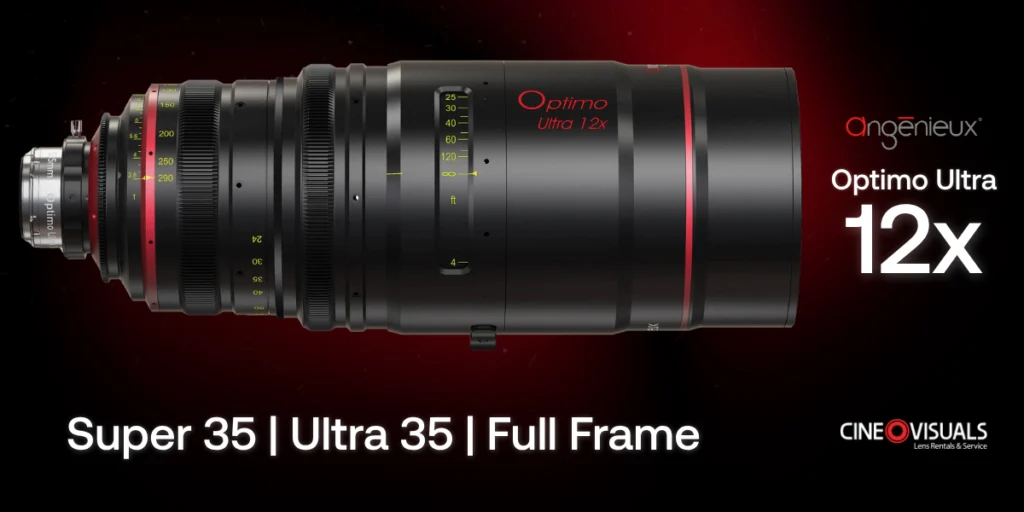
The Optimo Ultra 12x is not a small, lightweight lens. In its S35mm configuration, it weighs 27.7 lbs and measures nearly 19” in length. With the Full Frame rear optical adapter, the lens extends beyond 20” and approaches 28 lbs. Yet despite its imposing presence, the lens is engineered with a level of ergonomic refinement that reflects decades of experience in cinema mechanics for the use cases that it is designed for. The lens offers an extraordinary 321º of focus rotation, accompanied by more than 70 clearly marked focus positions along the barrel. For focus pullers, this extended rotation is invaluable. It allows extremely precise adjustments, particularly when working with shallow depth of field at long focal lengths. The focus ring itself is smooth and consistent, designed to work seamlessly with both manual follow-focus units and modern wireless lens control systems. Resistance remains stable throughout the rotation, preventing sudden jumps or inconsistencies during delicate focus pulls. Zoom control is equally refined. The zoom mechanism moves multiple optical groups in carefully coordinated motion to maintain parfocal performance. Even during rapid zooms, the lens maintains focus stability, a characteristic that remains surprisingly rare in complex long-range zoom designs.
Angénieux has a reputation for investing in the mechanical durability of their lens housings and the Optimo Ultra 12x is no different. Professional film production environments can be unforgiving. Equipment is exposed to dust, temperature fluctuations, and constant physical handling. Even with smaller primes these are difficult to manage – let alone large zooms as robust as the Optimo Ultra 12x. To address these realities, the zoom lens incorporates improved airflow pathways within the barrel to reduce the risk of dust being drawn into the optical assembly. Internal dust traps capture particles before they can reach sensitive components, while anti-abrasion coatings protect the exterior surfaces from wear. Temperature stability is another key feature. The lens is designed with passive athermalization, meaning its optical alignment remains stable across a wide temperature range. Whether filming in freezing alpine environments or under the intense heat of desert sunlight, the focus calibration remains reliable, which is much less common in housings, even modern ones, than many filmmakers are aware of.
The lens also maintains compatibility with standard cinema accessories. A large 162mm front diameter accommodates professional matte boxes and filtration systems, while the gear positions follow the established cinema standard for follow-focus and lens motor placement. Despite its size, the lens integrates smoothly into modern production workflows. For camera assistants, the experience of working with the lens feels deliberate and controlled. Every movement – whether focusing, zooming, or adjusting the iris – has been engineered to respond smoothly and predictably. This mechanical elegance is not merely a matter of comfort. On a professional set, reliability and precision translate directly into efficiency. When a lens behaves exactly as expected, cinematographers can concentrate entirely on the creative aspects of the shot.
Image Circle
One of the defining features of the Optimo Ultra 12x is its modular image circle architecture. Through Angénieux’s Interchangeable Rear Optics system, the lens can be configured to support three distinct imaging formats. Each configuration alters both the image circle and the effective focal range of the lens, allowing it to adapt to different production environments. In its S35 configuration, the lens covers a 31.1mm diagonal image circle. This format remains a cornerstone of modern cinematography and is widely used in both film and digital capture. In this mode, the lens provides a focal range of 24-290mm at a fast T2.8 aperture. The U35 (or Ultra 35) configuration expands the image circle to 34.6mm and adjusts the focal range to 26–320mm at T3.1. This format provides slightly greater coverage while maintaining a relatively bright aperture. Finally, the Full Frame configuration extends the image circle to an impressive 46.3mm, more than enough to cover the 43.3mm usually required to cover Full Frame. In this mode, the lens reaches a focal range of 36-435mm at T4.2. This modular approach allows cinematographers to use the same lens body across multiple camera platforms. Whether shooting on a traditional S35 system or a large-format digital camera, the optical character of the lens remains consistent.
Flare & Bokeh
Flare behavior is one of the most revealing aspects of a lens’s personality. It determines how the lens responds to intense light sources and how highlights interact with the optical system. The Optimo Ultra 12x employs advanced multi-layer coatings to control stray light while preserving a natural cinematic character. Rather than producing aggressive streaks or dramatic rainbow artifacts, the lens tends to generate subtle, controlled flares that maintain contrast within the image. Bright light sources produce a gentle veiling effect rather than overwhelming the frame. Highlights bloom slightly, creating a soft halo that enhances the atmosphere of the scene without washing out shadow detail.
Bokeh, meanwhile, reflects the careful design of the iris and optical geometry. The nine-blade aperture produces rounded out-of-focus bokeh that remains smooth even when the lens is stopped down. Background elements dissolve gracefully, allowing subjects to stand out without appearing artificially cut out from their surroundings. At longer focal lengths, this rendering becomes particularly striking. Distant lights transform into soft orbs, while textures fade into a creamy blur that emphasizes the dimensionality of the image. For cinematographers working with large-format sensors, these characteristics become even more pronounced.
These lenses are available for rent at Cine Visuals. For inquiries or testing appointments email info@cinevisuals.com or call (323) 244-2552.