




Loading cart...

Angénieux 25-250mm Zooms: Modernization of Kubrick’s Favorite Lens
Angénieux & Cine Visuals Present: Angénieux 25-250mm HR & OS Zooms
Cinematic Heritage
Nearly a century ago, in the quiet industrial landscape outside Lyon, Pierre Angénieux began experimenting with light not as a commodity, but as a language. When he founded Angénieux in 1935, the motion picture industry was still defining its technical identity. Lenses were largely designed through intuition and incremental refinement, and the idea of predicting optical behavior through computation was still emerging. Angénieux approached the discipline differently. He treated optics as both science and art, using early computational methods to design increasingly complex systems that others considered impractical. This mindset would lead him directly into one of the most difficult challenges in cinema engineering, the realization of a truly practical zoom lens.
In the early decades of filmmaking, cinematographers relied on prime lenses mounted to rotating turrets. Changing focal length meant interrupting the shot, physically swapping lenses, and resetting composition. Zoom lenses existed in theory, but they were plagued by instability. They could not maintain focus while zooming, exposure would shift unpredictably, and optical quality often fell far short of what narrative filmmaking required. The concept of parfocality, the ability for a lens to hold focus while changing focal length, was understood, but achieving it required extraordinary precision. Multiple optical groups needed to move in perfect synchronization, each compensating for the others in real time. For Pierre Angénieux, this was not a limitation but an invitation.
By the mid 1950s, his team introduced one of the first truly practical parfocal cine zooms, fundamentally altering the visual language of cinema. For the first time, cinematographers could reframe within a shot without sacrificing focus. The camera became more responsive, more observational, more alive. Documentary filmmakers could react in real time. Narrative filmmakers began to explore zoom as an expressive movement rather than a technical compromise. Through the 1960s and into the 1970s, Angénieux became synonymous with zoom design, and that reputation would crystallize with the introduction of the 25-250mm.
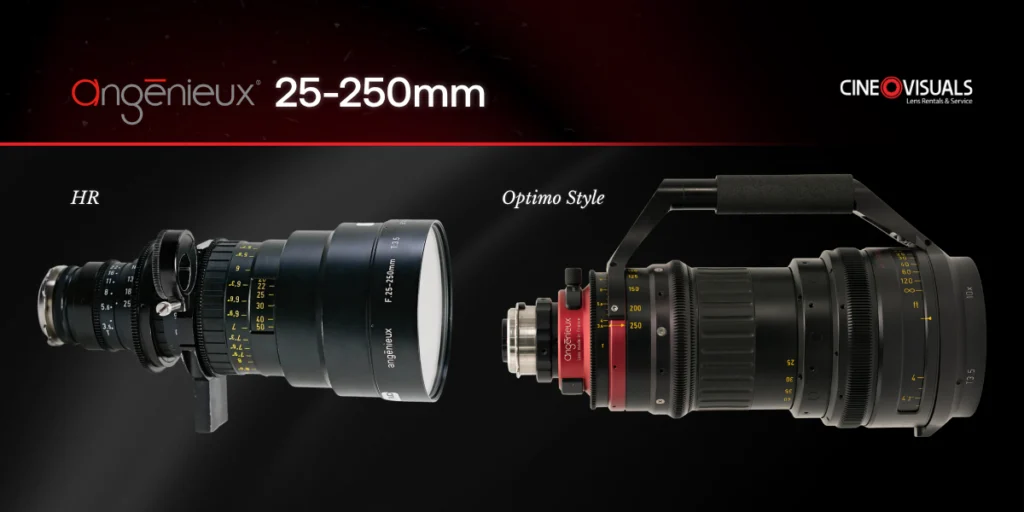
The original 25-250mm emerged during a period of rapid innovation. It was ambitious in both scale and intention, offering a 10x zoom ratio at a time when such range was considered extreme. More importantly, it delivered an image that felt cinematic rather than compromised. It was not perfect. It carried softness, flare, and optical quirks but those characteristics became its identity. Cinematographers embraced the lens not only for its flexibility, but for the way it interpreted light. It found its way into the hands of artists like Stanley Kubrick and Vittorio Storaro, where it helped shape the visual language of films that remain deeply influential.
As film stocks improved and expectations for resolution increased, Angénieux revisited the design. By the late 1980s, the lens evolved into the High Resolution variant. The 25-250mm HR retained the spirit of the original but introduced refinements in coatings, contrast, and sharpness. It became a bridge between eras, preserving the expressive qualities of the earlier lens while offering greater control and consistency.
In the early 2000s, as digital cinematography began to take hold, the lens underwent another transformation. The housing was redesigned in the style of the Optimo series, aligning it with modern mechanical standards and production workflows. While the external form evolved, the optical foundation remained closely tied to the HR design. This iteration, often referred to as the Optimo Style or OS, represents a convergence of past and present. It carries forward decades of optical philosophy within a housing built for contemporary filmmaking.
Image Fidelity & Focus
There is a distinct emotional quality to Angénieux glass that resists simple technical description. It is not defined solely by resolution or contrast, but by the way the lens interprets light and space. The original 25-250mm established this identity with an image that feels organic and expressive. Contrast is gently restrained, allowing highlights to bloom and shadows to retain depth without feeling crushed. The image does not present itself with clinical precision. Instead, it unfolds gradually, revealing texture and tone in a way that feels closer to human perception than mechanical reproduction.
At the center of the frame, the lens holds a reassuring level of sharpness, grounding the subject in clarity. Toward the edges, that sharpness softens, creating a subtle falloff that enhances the sense of depth. Focus transitions are equally expressive. Subjects do not abruptly separate from their surroundings. They emerge gently, with a smooth transition from sharpness into defocus that feels cohesive and natural. Backgrounds dissolve into a soft, painterly texture, while foreground elements fade without distraction. Breathing is present, and it is part of the language of the lens. As focus shifts, the frame subtly expands and contracts. In modern optics, this behavior is often minimized or eliminated, but here it contributes to the emotional rhythm of the image. A rack focus becomes more than a technical adjustment. It becomes a movement within the frame, reinforcing perspective and drawing attention in a way that feels almost subconscious.
The HR version refines these qualities without erasing them. Contrast is elevated, bringing greater clarity to midtones and improving separation between elements. Chromatic aberration is reduced, and resolution becomes more consistent across the frame. Yet the lens retains its warmth and its softness. It still feels like an Angénieux, but with a greater sense of control.
The Optimo Style pushes further toward precision. Sharpness becomes more uniform from edge to edge, and contrast is more pronounced. Breathing is significantly reduced, allowing focus pulls to feel more stable and less intrusive. With these optical improvements, the lens still maintains a subtle warmth and a gentle roll-off in highlights that preserves its cinematic identity. It is not entirely neutral. There is still a softness and warmth in the way it renders skin tones and a cohesion in the way it handles depth. The Angénieux look remains present, but it is expressed with restraint.
Handling & Adaptability
The evolution of the 25-250mm is as much mechanical as it is optical, and nowhere is that more apparent than in the transition from the HR design to the OS housing.
The HR version reflects a philosophy rooted in durability and practicality. With a length of 12.20in and a weight of just over 10 lbs, it strikes a balance between reach and manageability. The 136mm front diameter accommodates professional matte boxes and filtration systems, while the non-telescoping barrel maintains a consistent center of gravity throughout the zoom range. Focus rotation extends to roughly 280º, offering a level of precision that allows focus pullers to work confidently even at longer focal lengths where depth-of-field becomes increasingly shallow. Close focus sits around 5’ 7” providing enough flexibility for tighter compositions without compromising optical integrity. In practice, the lens feels grounded and dependable. It is substantial, but not overwhelming. For operators, it offers a sense of control. For 1st ACs, it provides the tactile feedback necessary for precise focus work. Its limitations are reflective of its era. Breathing is more pronounced, and the mechanics, while reliable, lack the refined smoothness of modern designs. Yet these characteristics are part of its charm. The lens feels mechanical in a way that connects the operator directly to the image.
The OS represents a shift toward modern expectations. The housing is longer, measuring 14.87in, and significantly heavier at around 16 lbs. This added weight reflects the complexity of the internal mechanics and the precision of the build. The focus rotation extends dramatically to 339º, providing exceptional control for focus pullers. The zoom rotation spans 170º, allowing for smooth, deliberate reframing. The 136mm front diameter is retained, ensuring compatibility with existing accessories, while the close focus is improved at 4 ft which expands creative possibilities. In use, the Optimo Style feels deliberate and refined. Every movement is smooth and consistent, designed to integrate seamlessly with modern follow focus systems and wireless motors. The extended focus throw allows for incredibly fine adjustments, particularly important in high resolution digital capture where even minor shifts in focus are immediately visible. The lens maintains balance despite its size, and the internal design ensures that operation remains predictable. The tradeoff is weight and length. This is not a lens designed for casual handheld work. It thrives in controlled environments where its precision can be fully utilized. For operators and camera assistants, it offers confidence. The lens responds exactly as expected, allowing the focus to remain on the frame rather than the mechanics.
Image Circle
The 25-250mm family was designed around the Super 35 format, a standard that has defined the visual language of cinema for decades. S35 refers to the active image area of 35mm film when used for motion picture capture, a format that balances field of view and depth of field in a way that feels both natural, cinematic, and familiar. Its diagonal measurement, typically around 31mm, became the benchmark for lens coverage as the industry transitioned into digital cinematography.
Both the HR and Optimo Style versions of the 25-250mm are built to cover this format fully. The HR lens projects an image circle of 30.4mm consistent with traditional S35 requirements, ensuring full illumination without strong vignetting across the frame. The Optimo Style extends this slightly, offering an image circle of 31.4mm. This additional coverage provides a small margin that ensures consistent performance across modern digital sensors, which often vary slightly in size depending on the camera system.
In practical terms, this means that both lenses integrate seamlessly into contemporary workflows. Whether mounted on a film camera or a digital system, they preserve the familiar spatial relationships that cinematographers have relied on for decades. The image retains its intended composition, and the lens performs consistently across the entire frame.
Flare & Bokeh
The HR version has a refinement in coatings that reflects the ‘70s but without the technical perfection of the modern era. Improved coatings (as compared to earlier single coating lenses) reduce the intensity of veiling flare, preserving contrast while still allowing light to interact with the optics in a controlled way. Highlights retain their shape more effectively, and the image feels more stable under challenging lighting conditions. Yet the lens does not lose its character. There is still a softness to the way it handles flare, a sense that light is being interpreted rather than strictly managed. The OS takes a more controlled approach. Advanced multi-layer coatings significantly reduce stray reflections, maintaining contrast even in the presence of strong light sources. Flare becomes more subtle, appearing as gentle artifacts rather than dominant visual elements. This control allows cinematographers to introduce flare intentionally, rather than working around it.
Bokeh across both versions remains one of the most compelling aspects of the design. Out of focus highlights are generally rounded, though they begin to take on a slightly elliptical shape toward the edges of the frame. This comatic aberration offers a cat-eye effect that introduces a sense of motion and depth, subtly reinforcing the dimensionality of the image. Backgrounds dissolve smoothly, creating a soft, cohesive texture that supports the subject without distraction.
These lenses are available for rent at Cine Visuals. For inquiries or testing appointments email info@cinevisuals.com or call (323) 244-2552.