

Loading cart...

How Leitz HUGO Primes Bring Leica M to Full Frame
Leitz & Cine Visuals Present: Leitz HUGO Primes
Cinematic Heritage
Photography and filmmaking saw explosive innovation during the late 19th and early 20th century. An era of inventors who dabbled in science and arts, often doing the former to achieve the latter. Something in the water created a craving for innovation. Among these early inventors was Ernst Leitz. A precision optics and microscope maker in the late 1800s. With the help of others, he took his designs to the world of filmmaking and Leica was born. As the company grew, Leica split its cinema lens division off and rebranded them as Leitz, in honor of their founder. Leica would focus on still photography cameras and lenses while Leitz would strictly operate on lenses designed for motion pictures.
In 1954, the Leica M Series was released for rangefinders. Legendary and a name every photographer knows. With its compact bayonet mount, photographers could take high quality imagery to otherwise difficult to reach situations in a lightweight, reliable, and beautiful design. These lenses have become a staple for artists spanning from street photographers to war correspondents to adventurers venturing from the highest peaks to the deepest forests. Hugo Wehrenfennig is the famed and honored optical technician who brought these designs to the world.
In September of 2016 the Leitz M 0.8 series were announced. Taking the impressive optical designs of the Leica M Series, Leitz created a new compact lens set specifically for motion pictures. Included in the name of the lenses, the lenses were reworked to have MOD 0.8 focus and iris rings that are cinema-industry standard. Instantly, their popularity surged. Accessible and ergonomic, the lenses could be fitted to small lightweight builds with a cinematic look or rigged for larger productions.
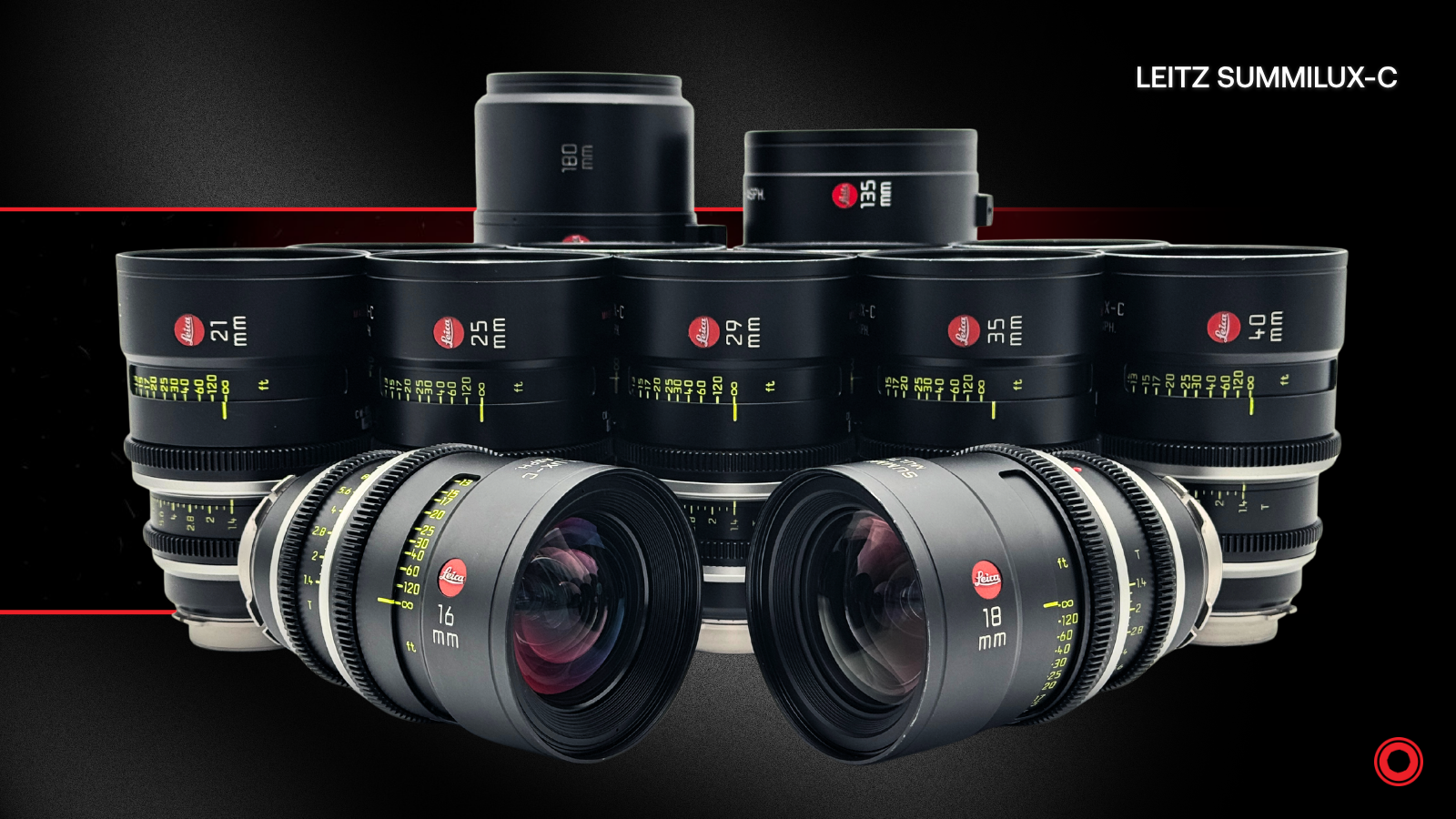
Leitz took these to the next level. In 2022, the company announced the Leitz HUGO Primes, naming them in honor of the original creator of the Leica M Series. Taking the blueprints for the Leitz M 0.8 lenses, Leitz brought the optics of Leica M into an even more standardized cinema-ready housing. These lenses would fit the modern housings and mechanical optimizations that are now often considered standard for productions. Incredible and beautiful.

Image Fidelity & Focus
Leica M Series glass has been well sought-after for over seven decades. Now, finally to the world of the film industry. The image is sharpest in the center without harshness. There is a grace to the crispness of the center without feeling clinical. Focus falloff gently rolls off creating a nice and neat circle around the center that feels natural. Organic color rendition brings warmth to skin tones and a coolness to shadows that adds a filmic quality to these lenses. Much of the industry shoots digitally now for workflow efficiency, but still longs for the quality motion picture film brings. HUGO Primes effectively bring that feeling back into the image. Leitz has brought the vintage characteristics of the Leica M Series into a state of control. Those slight aberrations and distortions have been tweaked to strike a balance between a natural-feeling touch and avoiding an over-corrected appearance. Each focal length in the series has been meticulously optimized with fast and accurate apertures. Across the set, the vast majority live at a T1.5 with the 135mm and 180mm living at T1.9 and T2 respectively. Demand for an even dreamier version of these lenses brought about the advent of the 50mm Noctilux with a true T1 speed. Fast and yet sharp without feeling clinical all the way wide open with a dreamy but not milky image.
Handling & Adaptability
Optimization is the goal with the Leitz HUGO Primes. Bringing Leica M glass and the Leitz M 0.8 housing to the standards of modern-day productions. Each lens has a front diameter of 95mm, across 13 different focal lengths. Unlike previous iterations of any Leica M Series lens, the focus rotation is 270º, allowing for accurate and smooth focus pulling. Ranging in length from 2.70” to 6.85” with half the set having a length of 2.70” (and the 18mm with 2.80”). Weights range from 1.78 lbs to 5.80 lbs with the average weight of each prime at about 2 lbs. These lightweight lenses have incredibly compact lengths with wide enough front diameters to allow for precise focus pulling and easy mattebox adjustments.
One of the most exciting innovative elements of the Leitz HUGO Primes are their field-swappable rear mounts. While ARRI LPL is the standard, both Leica M or L mounts can be adjusted to the lens while on set. Something to note about the Leitz HUGO Primes is their mounting compatibility with cameras. As with many lenses designed for rangefinder cameras, the rear element has a deeper protrusion for its functionality and this holds true for the Leitz HUGO Primes. For some cameras with shorter flange focal distances, an LPL adaptor is needed. This is the case with Sony Venice cameras, which require a mount adaptor such as the Wooden Camera LPL Mount Adaptor for Sony Venice (available for rent here at Cine Visuals). This adaptor works for both Venice 1 & 2 as well as the Burano. The lenses are natively compatible with the ARRI LPL mounts of the ARRI Alexa35, Alexa LF, and Alexa Mini LF. However, the flange distance of the Alexa Mini or traditional motion picture film cameras are not compatible though there are LPL mods that can be made to make them so.
Image Circle
Based on the Leica M Series which were designed for rangefinders, the HUGO Primes cover Full Frame. Still photography rangefinders exposed 35mm film horizontally at 8-Perf which is the inspiration for VistaVision and Full Frame. Thus, these optics were designed to cover a large image circle for 43.3mm. Full Frame coverage is now expected for modern productions, and thus the characteristics of Leica M lenses brought to modern productions makes the Leitz HUGO Primes excellent Full Frame lenses. Every focal length in the set has an image circle of 43.3mm, which easily covers the minimum area needed for Full Frame. This makes these lenses a perfect fit to bring a filmic quality to Full Frame digital cameras.
Flare & Bokeh
Leitz HUGO Primes strike an incredible balance between expressive and controlled flares. Multi-layed translucent circles reflect through the glass to create beautiful flares filled with color. With white light sources, the flares create two major circles with the internal, smaller flare taking a cool blue-violet appearance while the external, larger circle takes on a warmer yellow-green tone. Though the circular flares are close, inside their edges they are filled with white halation that casts a slight warm glow across the frame. With a fast aperture and 11-blade iris, the bokeh is smooth and bubbly. Common among vintage glass, the bokeh is swirly and takes on a cat eye crescent in a wide circle around the center of the frame. Each circle of bokeh feels wild and free, with unique and slightly distorted shapes. None is quite like the other giving an organic beauty to the character of the bokeh.
These lenses are available for rent at Cine Visuals. For inquiries or testing appointments email info@cinevisuals.com or call (323) 244-2552.