


Loading cart...

Canon Cine-Servo Zooms: Cinematic to Broadcast
Canon & Cine Visuals Present: Canon Cine-Servo Zooms
Cinematic Heritage
In the early 2010s a new age was rising into the world of filmmaking. A digital age. While the usage of digital cameras for cinema and television had been around for the 2000s, with major blockbusters utilizing them as early as “Attack of the Clones” (released in 2002), the standard remained traditional motion picture film. These early films used cameras such as the Panavision Genesis or the Sony CineAlta line-ups. The RED One’s release revolutionized the commercial and television worlds. However, these cameras were most often still considered not up to snuff for high-end cinema. Later iterations of RED and Sony cameras would aid in changing this, but the real game-changer was the ARRI Alexa often now dubbed the ARRI Alexa Classic.
However, digital cameras have been around for many years. Cathode-tube technology has been around since Philo Farnsworth invented television in his San Francisco apartment in 1927. By the 1980s charge-coupled device image sensors (often called CCD sensors) had become effective enough for portable cameras. Media was stored on tapes, which would continue as the main source of digital media even into the Panavision Genesis, which could also utilize solid state drive via flash storage as an up and coming innovation. Broadcast, documentary, and some television (typically non-narrative) quickly adopted this technology as their primary source of capture. The ergonomics outweighed the loss in image quality for these types of productions.
Rewinding, Canon is a company that has been famed for its innovative glass for decades. The continued usage of their Canon K35 and FD mount glass lenses are evidence of their success. As early as the late 1960s, Canon was investing in parfocal, ergonomic optical zoom technology for cinema. However, with this digital broadcast revolution, Canon wanted to create lenses that were lightweight, fast, and efficient. Zooms are highly efficient for framing, but their additional optical elements make them heavy and cumbersome for operating. However, for broadcast, ergonomics and speed of capture is the priority. Canon decided to divide their zoom product R&D. One type of zoom lens would be designed with cinematic quality in mind with manual focus and housing that was effective but not necessarily optimized for the usage in cinema. The other side, mainly for broadcast, was designed with efficiency and ergonomics in mind. This led to the original Servo Zooms in the late 1960s that surged in popularity and became the broadcast standard by the early 1970s.
A servo is a small electric motor system that greatly increases the efficiency of the working operations of a lens, particularly a zoom lens. With a zoom lens there are three rings: one for aperture, one for focus, and one for zoom. On narrative motion picture film sets, crews are large with multiple assistants helping the operator in the functionality of the cameras. Movements are planned, practiced, and given time to achieve a look. With broadcast, that time has never been so available. Reporters are on the ground capturing people in real life while sports or concerts are happening in the moment – no rehearsals and no redos. On top of that, operators typically work alone. Instead of a single camera with multiple people working, there are many cameras each with one person operating them. Operators need to be alert and quick. They need to be able to rely on their equipment to function. They don’t have time or brain-space to communicate something to a camera assistant – they need to act. The invention of the Servo was incredible for this purpose. The Servo allowed easy, precise, and reliable control over the zoom lens for operators. Operators could now control all the mechanisms of the zoom lens from a pan handle, a shoulder ring, from the servo directly, or even remotely. The act of a zoom can be controlled or “power zooms” can be achieved. No human wobble or unpredictability. Focus can be quick, precise, and easily changed.
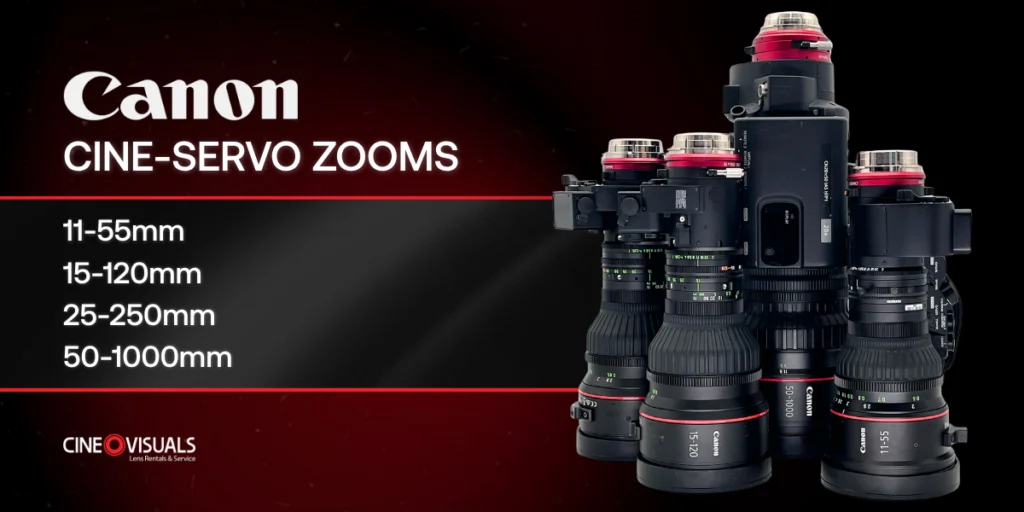
Bringing everything together, the digital age has now reached even high-end motion pictures. Many broadcast and documentary productions now regularly use high-end digital cinema cameras. One of the new dreams of these productions has been finally bringing that cinema-quality look so often sacrificed for ergonomics and efficiency. In 2014, Canon announced the first true “hybrid” lens, as some marketing called it at the time. The Canon Cine-Servo 17-120mm T2.95. Canon went to work on their cinema-line glass and reworked their mechanical designs with their long history of Servo lenses. What was born from this experimentation was the beginning of the Cine-Servo line of lenses. Lenses that had the optical quality of cinema glass with the ergonomics and precision of Servo technology. As expected, they became an instant hit. Later that year, Canon followed up with the 50-1000mm as an extreme magnification zoom to accompany use cases where very long lenses needed to be used. In fact, this exact lens was born from a request by a wildlife filmmaker who loved the Cine-Servo 17-120mm but needed more distance and focal range flexibility between the camera and the subject. During the 2020s, three more zooms were released in the series with focal ranges of 25-250mm, 15-120mm, and 11-55mm each with built-in extenders to make them readily compatible with both Super 35mm and Full Frame sensors.
The most recent of these, just announced in September 2025 and released in early 2026, is the impressively compact 11-55mm. For many live events, on-the-ground operators wanted wider focal lengths to accompany their zoom. Thus, a compact servo zoom was created in the 11-55mm to give operators that flexibility in range all with the same high quality cinematic Canon Cine-Servo look. A long awaited addition that offers all the power of a Servo, cinematic optics, and the flexibility of a wide-angle zoom. All of these lenses, the entire Cine-Servo line, is available for rent here at Cine Visuals.
Image Fidelity & Focus
Prime lenses can often be more finely-tuned to a specific look. With the various focal ranges in zooms, this achievement can be difficult. To perfect the zoom with a prime-like appearance often makes the zoom lens heavy, cumbersome, and expensive. So a balance is often struck between optical imagery, ergonomics, and price.
A massive appeal to many filmmakers is the “prime-like” appearance of the Canon Cine-Servos despite their otherwise lightweight design and high efficiency Servo technology. A difficult balance between broadcast and narrative motion picture is the overall goal of these lenses. Broadcast’s goal is to capture the reality of the moment with clarity. Motion picture films seek to communicate a story via feelings. One takes a more objective approach and the other a more artistic approach. However, filmmakers have sought to merge the two together in a balanced and effective way. With the invention of Canon’s Cine-Servo Zooms, this bridge has been built.
Center sharpness is a key factor in the image quality captured by Cine-Servo glass with gentle falloff near the edges to give that reminiscent cinematic quality. However, many zoom lenses suffer from decreased sharpness and vignetting on the edges of the frame especially on the wider end of the focal range. This means that the focal range does not exactly match from one end of the focal range to the other. Canon Cine-Servo Zoom optics are designed to maintain the same quality image across the focal range, with the same gentle focus falloff but prioritizing sharpness with no vignetting. This makes them a powerful tool for broadcast and capture whilst still having a cinematic quality to them.
Handling & Adaptability
Servo technology is a must for broadcast scenarios. Mechanical designs that allow filmmakers a much greater efficiency in their work. The Servo allows operators to easily and smoothly control aperture, focus, and zoom from a variety of access points. Either from easy to use buttons on the Servo system itself, from the pan handle, the shoulder rig, or even remotely. A key factor is that operators don’t have to worry about smooth timing as many focus pullers must take special care to do. The mechanical design keeps the movement smooth and unnoticeable to viewers, so that operators can focus on the creative frame rather than struggling with the technical.
Canon Cine-Servos really shine with their ergonomic design. Each zoom has its own unique offering, making the line of Cine-Servos an incredible pairing for any situation, particularly high-speed or live filmmaking situations. With the original Canon Cine-Servo 17-120mm weighing only 6.40 lbs and measuring 10.45 inches, the lens was incredibly versatile while still giving a high quality image.
Coming out later that same year, Canon brought even more innovation to their new Cine-Servos. In situations where a great magnification is needed, the 50-1000mm performs well weighing only 6.70 lbs with a length of 11.10 inches. In nearly the same form factor as the 17-120mm, Canon fit the 50-100mm. Together, any filmmakers would have the extensive range they need for high speed production. However, these well sought after innovations to the film industry were only the beginning. Canon would release three more lenses for this series as of today.
Canon came out with an alternative mid-range Cine Servo Zoom, the 25-250mm. This mid-range zoom lens could strongly cover wides while also having the flexibility for long zooms and true telephoto shots. By 2022, Canon went back to optimize their original Cine-Servo. They released the 15-120mm as an update to the original 17-120mm. Giving the lens a slightly wider end point in the focal range, they updated the mechanics, giving it a 1.5x extender making the lens compatible with Full Frame for a modern large format world. As mentioned earlier, in 2026 the 11-55mm was released, adding a compact wide angle zoom that gives great flexibility for operators in fast-paced and close-up situations, now added into the line of Canon Cine-Servos available here at Cine Visuals.
Each of these lenses and especially together as a kit can be brought for live events, broadcast, documentaries, nature filmmaking, and more with easy swaps and operators having little adjustment to their rigs as the weights and lengths of each lens matches. And alone each zoom works as a powerhouse in its intended environment whether that is long distance nature shots or up close and high paced live events. This gives filmmakers high quality cinema glass with Servo technology and a combined focal range of 11-1000mm.
Each of these lenses is embedded with Cooke/i Technology and Zeiss eXtended Data. Canon Cine-Servo lenses have metadata tied with the lens. This allows the lens and camera to communicate and write information into the recording format that greatly speeds workflow in post and transfers troublesome on-set data collection to the mechanics so the camera team can focus on the creative.
Image Circle
Designed for Super 35mm, the Canon Cine-Servos all have a native image circle of 29.6mm which easily and completely covers a Super 35mm sensor. However, with the rise of Full Frame in the last ten years, Canon has updated their Cine-Servos to bring them into the modern era. Each lens in the set has an optional built-in 1.5x extender that brings the image circle to 43.3mm that allows the lenses to completely cover Full Frame. The exception is the 17-120mm, which was the first in the Cine-Servo line and was not designed with the built-in extender.
Flare & Bokeh
In many live event or documentary work, light sources are simply present in the world. Uncontrolled in the wild. When finding frames and important moments to capture, operators need flexibility and can’t afford to worry about controlling flares. Thus, the coatings imbued into Canon Cine-Servo glass control flaring and bring them to a minimum, even when a light shines directly into the lens. Flaring is contained and gentle. With an 11-blade iris, bokeh remains smooth and round. A naturally circular bokeh will complement narrative work, and yet the bokeh remains subtle as to not be a distraction from the frame. In essence, bokeh adds an artistic touch to the lenses while still remaining crisp and controlled making them ideal for broadcast and documentary work.
These lenses are available for rent at Cine Visuals. For inquiries or testing appointments email info@cinevisuals.com or call (323) 244-2552.